
Turning Points · 9 to 10 November 1938
What was Kristallnacht? The Night of Broken Glass, November 9 and 10, 1938
What happened on the night of November 9, 1938, who was holding the camera, and the survivors who described it in their own words.
Project Witness records and preserves Holocaust survivor testimony. This page is free to use, in classrooms and out of them.
Written for readers 14 and up. Some pages describe killing methods and public humiliation.
On the night of November 9 and 10, 1938, Nazi Party organizations and ordinary Germans across Germany and annexed Austria burned more than 1,400 synagogues, prayer houses and smaller places of worship, broke into Jewish homes, killed hundreds of Jews, and arrested about 30,000 Jewish men, roughly 26,000 of whom were imprisoned in Dachau, Buchenwald and Sachsenhausen.
It did not stop after one night. The German decree that followed dates the damage to November 8, 9 and 10, and in some places the attacks went on longer.
Watch, 0:39:03 Free, no sign-up
Kristallnacht: the short answers
- What it was
- A pogrom against the Jews of Germany and annexed Austria on the night of November 9 and 10, 1938, carried out by Nazi Party organizations and by ordinary Germans. Synagogues burned in public. Homes were broken into. Tens of thousands of Jewish men were arrested for nothing but being Jewish.
- When
- It peaked on the night of November 9 and 10, 1938, and was called off by radio at 4 in the afternoon on November 10. It did not end there. Attacks ran on in places to November 12 and 13, in annexed Austria they began only on November 10, and the German decree that followed dates the damage to November 8, 9 and 10.
- What the name means
- Crystal night, meaning the glass in the streets. The regime called the operation an Aktion. Jews called it a pogrom. Reichskristallnacht arose among the German public and was later shortened. Yad Vashem objects that the word points at property, which for many of the victims was not the most significant part. The Holocaust Memorial Museum records that German today commonly says Reichspogromnacht or Novemberpogrom. Neither is a settled answer, and Reichspogromnacht keeps both the Reich prefix and the word night.
- Who ordered it
- Propaganda Minister Joseph Goebbels set it going with a speech in Munich, and his own diary records Hitler ruling that the demonstrations were to run on and the police to withdraw. Gestapo chief Heinrich Mueller ordered mass arrests at 11:55 that night, and Heydrich issued police instructions at 1:20 in the morning. The party's own court later found that the party had organized the violence while arranging not to appear as its author.
- How many synagogues
- More than 1,400, counting synagogues together with prayer houses and the smaller rooms communities prayed in. The lower figure near 267 that also circulates is arithmetic on Heydrich's report to Goering, which counted 191 synagogues set on fire and 76 completely destroyed inside about thirty-six hours and said of its own figures for shops and houses that they must have been exceeded considerably.
- How many were killed
- Hundreds. The United States Holocaust Memorial Museum prints no numeral at all: hundreds of Jews died during the pogrom and its aftermath, and hundreds died by suicide. The Jewish Museum Berlin gives approximately 400 murdered or driven to suicide. The familiar 91 is not a death toll. It is the number of killings the Nazi Party's own court still had under police investigation in February 1939.
- How many were arrested
- About 30,000 Jewish men. The United States Holocaust Memorial Museum gives approximately 30,000 arrested and about 26,000 of them imprisoned in Dachau, Sachsenhausen and Buchenwald. The rest were held in local prisons and police stations and released without reaching a camp.
- What changed afterward
- The victims were billed for it. On November 12 the regime fined German Jews one billion Reichsmarks, made them pay to repair their own wrecked property, confiscated the insurance money owed to them, and barred them from retail and trade. Jewish children were expelled from German public schools three days later.
Each of these has a fuller answer below.
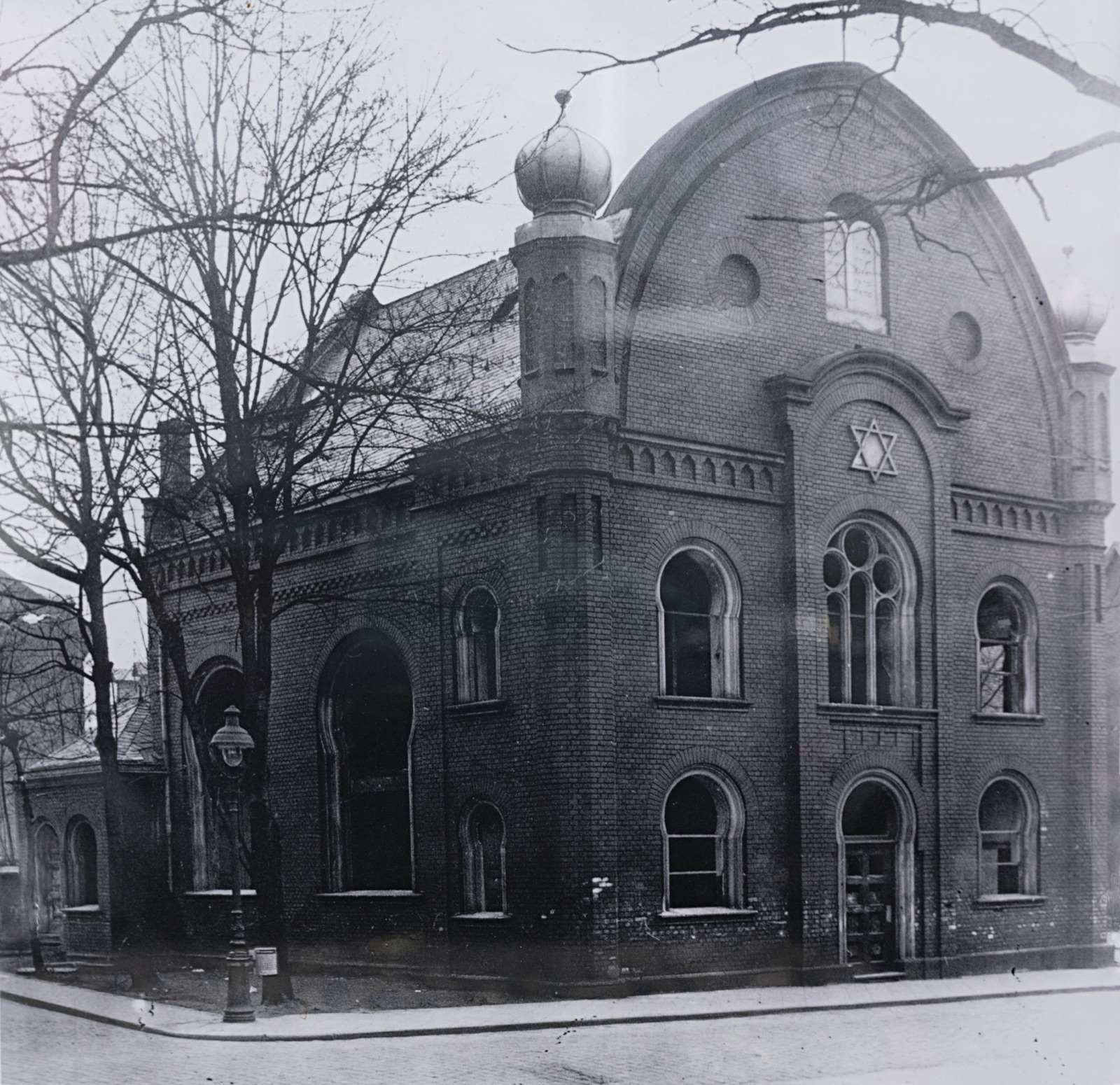
Photographer unknown · 1938-11-10 · Stadtarchiv Frankfurt am Main, via Wikimedia Commons Public domain View the record: This is the day after, November 10, 1938, in the Hoechst district of
What was Kristallnacht?
The definitional answer, and what made November 1938 different from the five years of persecution before it.
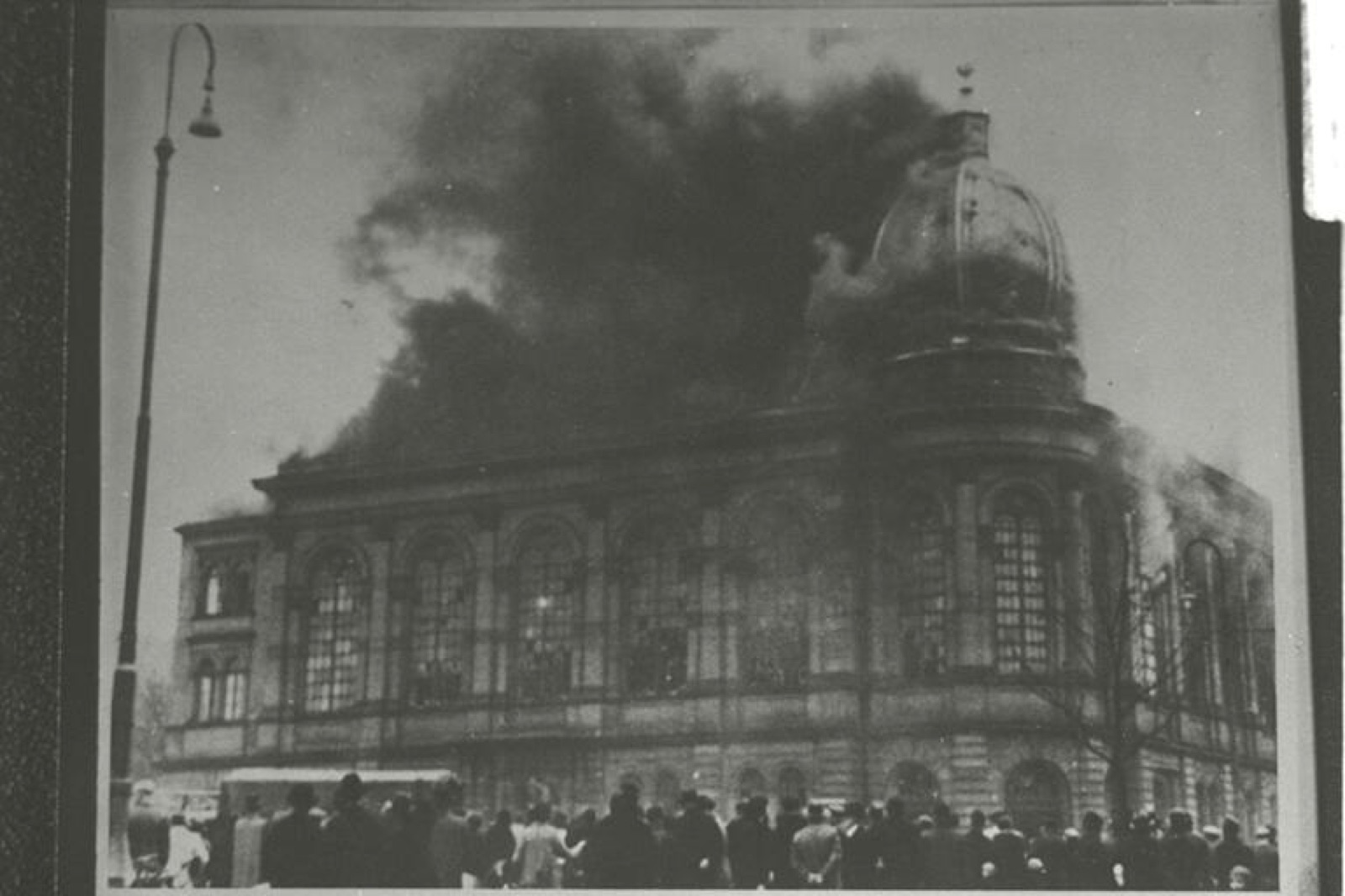
Photographer unknown · November 1938 · Leo Baeck Institute, New York, published on Flickr Commons by Center for Jewish History, NYC, National Socialism Collection, AR 119 No known copyright restrictions; may be subject to third party rights. Flickr Commons usage: rights statement for The Leo Baeck Institute, which holds this print, records no View the record: The Leo Baeck Institute, which holds this print, records no
Kristallnacht was a pogrom against the Jews of Germany and annexed Austria on the night of November 9 and 10, 1938. Nazi Party organizations set it going on Goebbels' instructions and ordinary Germans joined in, with the police ordered to pull back and let it run. Synagogues burned in front of crowds through the night and into the next day. More than 1,400 synagogues, prayer houses and smaller places of worship were destroyed, thousands of Jewish businesses were wrecked, hundreds of Jews were killed, and about 30,000 Jewish men were arrested.
It was not a riot that got away from anyone. The order to arrest Jewish men was written before most of the burning started, and the police instructions that followed it told forces across the country not to interfere. Three months later the Nazi Party's own Supreme Court reported to Goering that the party leaders who had been in the room in Munich had probably all understood Goebbels the same way. The party was to organize the violence and carry it out, and was not to be seen publicly as its author.
Vandalism and assault were not new in 1938. The Holocaust Memorial Museum locates the significance somewhere else: assault, robbery, arson and looting happened all at once, in a short span of time, across a whole country and its annexed territories, in the open. Each strand of it took away a different protection. Wrecked shops pushed Jews further out of the economy. What burned with the synagogues was the most visible form of Jewish life on a German street. And the arrests were the first time the regime jailed Jews on that scale for nothing but being Jewish, with the men often marched to the police station through streets full of their neighbors.
The Holocaust Memorial Museum singles out one shock in particular. Until then most anti-Jewish measures had been public and had touched work and business. This one came through the front door of the house.
I remember my mother standing pale and crying... I remember her phoning her gentile friends, she had more gentile friends than Jewish friends, No answer. No one answered her.Professor Zvi Bacharach, ten years old in Hanau in November 1938. Yad Vashem, online exhibition, The November Pogrom.
Why is it called the Night of Broken Glass?
The regime had its own word for it. German authorities called the events an Aktion, an operation, and sometimes the Jewish action or the revenge action. Jews called it a pogrom, a Russian word in use since the nineteenth century for mass violence against Jews, and by reaching for it they placed the night in a much longer history. American newspapers used pogrom too. Reichskristallnacht, Reich crystal night, came up among the German public during the Nazi period and was later shortened. Jewish contemporaries also called that week Murder Week, the Grynszpan Affair and Glassed Thursday.
Yad Vashem's objection is that the word points at property. It names the glass, which for many of the people it happened to was not the most significant part. The Jewish Museum Berlin sets the word in quotation marks and says it is avoided in German today as a euphemism, and that night is misleading because the violence continued by the light of day. The same museum raises a second objection almost nobody else prints. Pogrom means violence begun by ordinary people, so using it can hide how central the German state was to planning and directing what happened.
The replacements are not clean either. The Holocaust Memorial Museum records that German today commonly says Reichspogromnacht, Reich pogrom night, or Novemberpogrom, November pogrom. Reichspogromnacht keeps both of the words at issue. It keeps Nacht, which the Jewish Museum Berlin's objection lands on exactly as it lands on Kristallnacht, and it keeps the Reich prefix that entered the language during the Nazi period, in Reichskristallnacht. Institutions print what they prefer. The German Historical Museum heads its account in the plural, Novemberpogrome 1938, which gives up the single night and the Reich at once, and the Jewish Museum Berlin heads its page 9 November 1938, with Kristallnacht in quotation marks.
The argument about the word night has a documentary answer, and it comes from the perpetrators rather than from later scholarship. The German decree that followed the pogrom puts its own dates on the damage. It is printed below, in the section on when this happened.
This page keeps Kristallnacht in its title because that is the name most people know it by, and uses November Pogrom where the sense requires it.
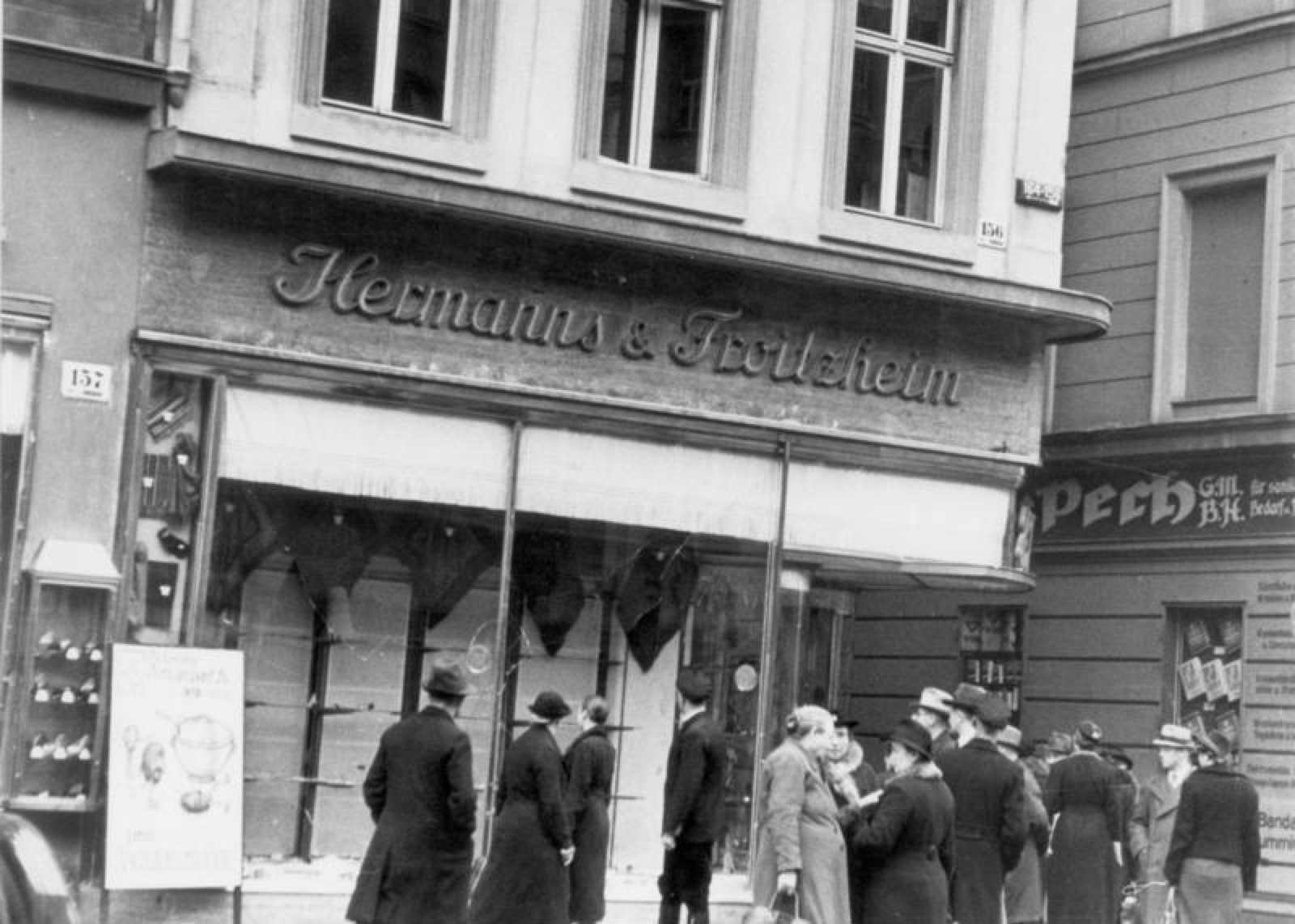
Photographer unknown · November 1938 · Bundesarchiv, Bild 146-1979-046-19 CC BY-SA 3.0 de: licence for This is the broken glass the name points at, and the least of what View the record: This is the broken glass the name points at, and the least of what
What led up to it: Germany in 1938
Kristallnacht did not fall on a quiet year. Germany annexed Austria on March 11 through 13, 1938, and anti-Jewish violence began the same night, worst of all in Vienna. The annexation brought about 185,000 more Jews under Nazi rule at a moment when roughly 150,000 German Jews, one in four, had already gone. In June the Criminal Police arrested around 12,000 men labeled asocial or professional criminals, and Heydrich told them to take in Jewish men with even minor records; the Holocaust Memorial Museum calls that the first mass arrest of Jews in Nazi Germany. On August 20 Adolf Eichmann opened a Central Office for Jewish Emigration in Vienna to move people out faster. The policy was already expulsion. What it lacked was anywhere to expel them to.
Delegates from thirty-two countries met at Evian-les-Bains in France from July 6 to 15, 1938 to talk about the refugees. Roosevelt had called the meeting and sent a businessman, Myron C. Taylor, rather than a senior official. Speaker after speaker expressed sympathy. Only the Dominican Republic said it would take significant numbers. The conference closed having created a committee and no quotas. Australia's delegate, T. W. White, told the room, "As we have no real racial problem, we are not desirous of importing one..." The Holocaust Memorial Museum records that the German government responded with satisfaction, remarking that foreign countries criticized Germany over the Jews and would not open their own doors when the chance came.
The paperwork closed in the same months. A decree of August 17 required every Jew without an approved Jewish first name to add Israel or Sara by January 1, 1939, and to use it in business. On October 5 German Jews' passports were invalidated, and became valid again only when stamped with a red J. Yad Vashem records that the stamp was introduced at Switzerland's request, so that Swiss officials could turn German Jews back at the border.
The last push before Paris came from two governments at once. Poland had passed a law on March 31, 1938 allowing it to strip citizenship from Poles who had lived abroad continuously for at least five years and had lost their ties to the Polish state, and in early October it ordered that passports held abroad be endorsed at a consulate, with a deadline at the end of the month. Germany delivered an ultimatum on October 26, and when nothing changed a circular went out to every State Police office ordering every Polish Jew holding a valid passport taken into custody and moved to the border at once.
Between October 27 and 29 more than 17,000 people were arrested in their homes, allowed a few possessions and put on guarded trains. Most were long-term legal residents of Germany and many had been born there, which conferred nothing, because German citizenship passed through parents rather than birthplace. Poland would not let them in and Germany would not take them back. More than 8,000 were left at Zbaszyn, a town of about 5,400 people, in old military stables, a school, a mill and a shooting range, and some stayed for months. In the town a Jewish hospital, a school, kitchens, a post office and a choir were set up. Emanuel Ringelblum came from Warsaw and spent five weeks organizing relief. Two years later he founded the clandestine archive of the Warsaw ghetto.
Watch, 0:43:38 Free, no sign-up
the venerable Rav of Nuernberg, Rav Klein, appeared together with a Jewish taxidriver carrying crates of milk etc. for the childrenShammai Zahn, on the hall at Nuremberg railway station during the Polenaktion, where hundreds of women and children were held with no food for the babies. Zahn names the rabbi only as Rav Klein, the venerable Rav of Nuremberg. Yad Vashem, Jewish communities, Wurzburg.
Among the deported were Zyndel and Ryfka Grynszpan, who had come to Germany in 1911 and were put across the border from Hanover with two of their children. They got word to their seventeen-year-old son Herschel, who was living in Paris. On the morning of November 7, 1938 he walked into the German Embassy there and shot Ernst vom Rath, a junior diplomat, wounding him mortally. Grynszpan was handed over to the Germans by the Vichy government in 1940, and the date and place of his death have never been established.
Why did Kristallnacht happen?
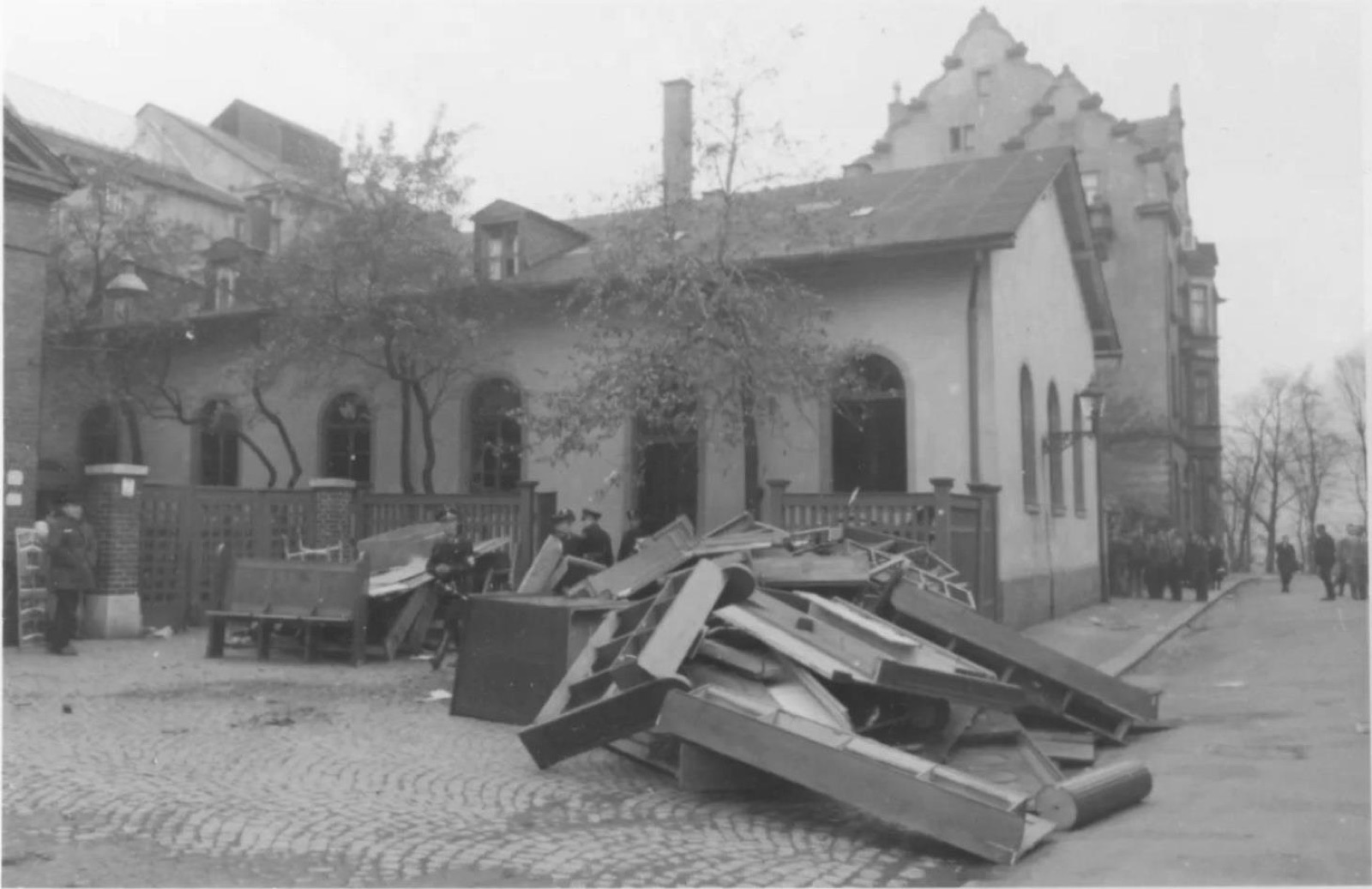
Photographer unknown · 1938-11-09 · Private collection, via Wikimedia Commons Public domain View the record: Hof an der Saale, in Upper Franconia, on November 9, 1938. A
The answer has two parts and most short accounts fuse them. A seventeen-year-old shot a German diplomat in Paris, and the regime used it. That is the pretext. The cause was a policy of forced expulsion that had been running at speed all year.
What is established about Herschel Grynszpan's motive is narrow. The Holocaust Memorial Museum writes that he likely acted out of anger over the deportation of his parents, his siblings and other Jews with Polish citizenship, and the word likely is the museum's own. He gave more than one account of himself in custody, first to the French and then to the Germans, and the accounts do not agree. The later account came from a young man in German hands, facing a show trial, with an obvious reason to say whatever might prevent it. That account reaches us through a university's write-up of the historian Alan Steinweis's work rather than through an archival record, and the write-up says most historians do not subscribe to it.
The riot was organized, and the men who organized it expected to be disbelieved. From November 7, two days before vom Rath died, Goebbels was directing the German press response and Nazi papers were blaming all Jews for the shooting. Goebbels wrote in his own diary that Hitler had ruled the demonstrations should be allowed to run on and the police pulled back. The party's own supreme court said as much to Goering three months later.
It has been ascertained by this office that the plan of "spontaneous indignation" leaked out in Leipzig several hours before news of the death of Third Secretary von Rath had been broadcasted...
David H. Buffum, American Consul, Leipzig, Anti-Semitic Onslaught in Germany as Seen from Leipzig, November 21, 1938. Public domain, a work of the United States government. Photocopy contributed to the Internet Archive by Abilene Christian University Library. View the record: David Buffum, the American consul in Leipzig, wrote his report on
The people doing it were not only men in uniform. The Holocaust Memorial Museum names party officials and members of party organizations, especially the SA storm troopers, the SS and the Hitler Youth, and German civilians who belonged to none of those organizations. Many took the chance to steal from Jewish homes and shops and to humiliate their Jewish neighbors in public. Alan Steinweis, working through the records of more than a thousand postwar trials, found the participation far wider than the standard account allowed. Counting looters, spectators at synagogue fires and people who egged the SA on, he puts the total in the tens of thousands, and argues that the tidy top-down version of the night has served as an excuse for ordinary Germans.
They were young academics, lawyers and physicians. They were sons of well-respected businessmen, who will now forever shame the German people. I always remember the name of Sander, the jeweler who had a shop that he had stolen from Jews on the Steintor that is on Georgstr. He committed outright robbery.Hans Block, a lawyer and notary of Hanover, writing in December 1939 after his release from Buchenwald. Yad Vashem Archives.
When was Kristallnacht? The night, hour by hour
The night of November 9 into November 10, 1938. That is the answer to the question as people ask it, and it is not the whole answer. The Holocaust Memorial Museum writes that the riot lasted about twenty-four hours. Yad Vashem writes that the attacks peaked on the night of November 9 and 10 and continued in some places into November 12 and even 13. In annexed Austria they did not begin until November 10. The German state settled the point in its own statute book: the decree of November 12, 1938 on restoring the streetscape dates the damage to the eighth, ninth and tenth of November. Three days, on the perpetrators' own paperwork.
Nazi Party leaders were in Munich on November 9 for the annual commemoration of the 1923 Beer Hall Putsch, Hitler's failed attempt to seize power, which is why the party's leadership from across Germany was in one city on the night the pogrom began. That evening they learned that vom Rath had died in Paris. Between about 9:30 and 10, Goebbels gave the gathering an antisemitic speech about the shooting. The officials in the room then went to the telephones and passed his instructions down to their home districts.
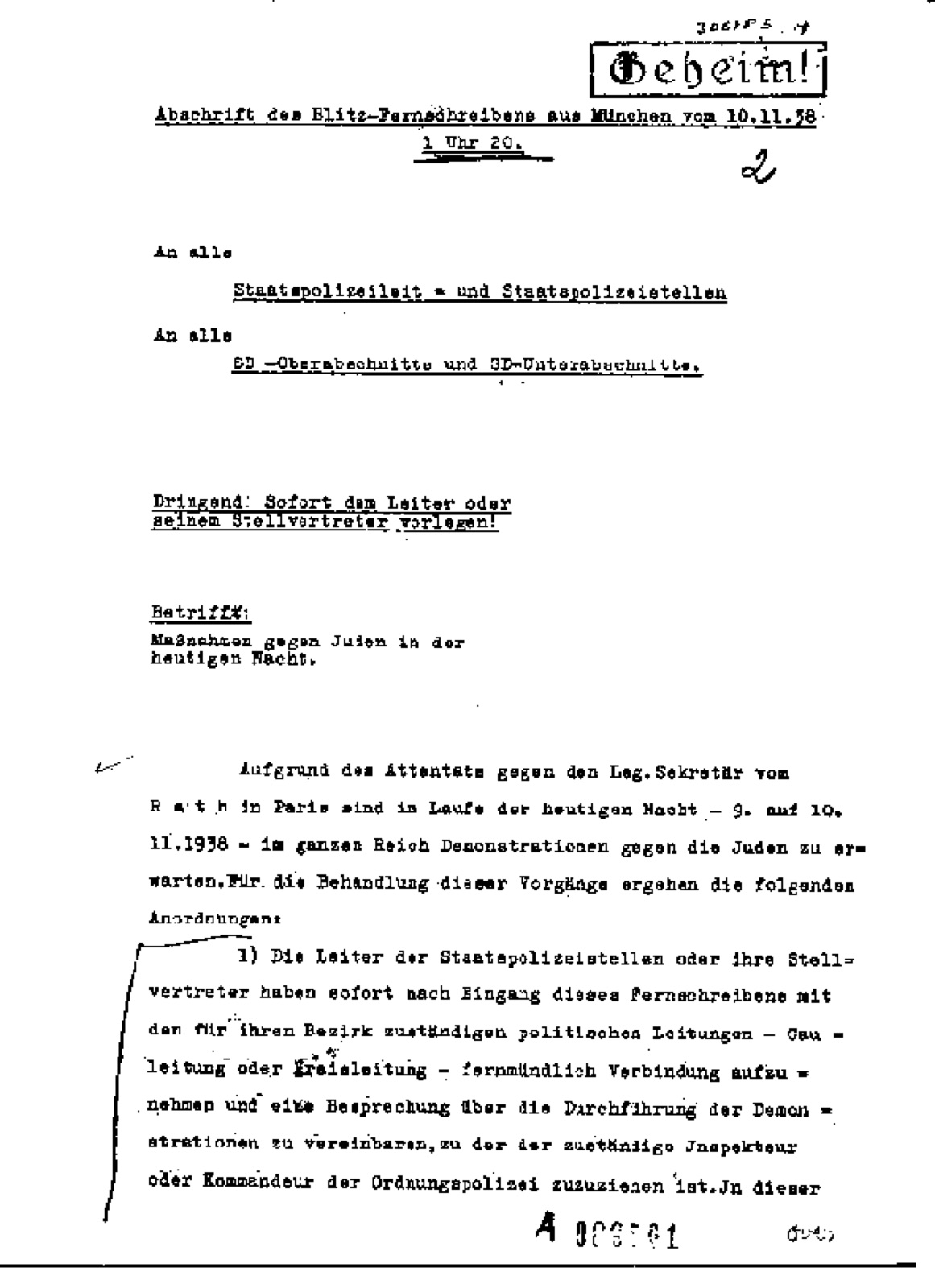
Only such measures are to be taken as do not endanger German lives or property (i.e., synagogues are to be burned down only where there is no danger of fire in neighboring buildings).
Teleprinter order signed by Reinhard Heydrich, Chief of the Security Police, to all Gestapo and SD offices, 1:20 a.m., November 10, 1938. Nuremberg document 3051-PS. National Archives and Records Administration, captured German records; the German document is in the public domain. English translation from Yitzhak Arad, Yisrael Gutman and Abraham Margaliot, eds., Documents on the Holocaust (Jerusalem: Yad Vashem, 1981), pages 102 to 104, quoted in part. View the record: Reinhard Heydrich's teleprinter order to every Gestapo office and to
Two orders went out that night, and the sequence is the thing to hold on to. At 11:55, before most of the violence, Gestapo chief Heinrich Mueller sent an internal notice ordering the arrest of 20,000 to 30,000 Jewish men and telling police to concentrate on the wealthy. At 1:20 the following morning Heydrich sent longer instructions to police forces across the country: do not interfere with what he called the demonstrations, remove the synagogue archives and hand them to the Security Service, arrest young, healthy, well-off Jewish men. So the arrest order came first, and the instructions that followed it did not start the fires. They set the terms the fires were allowed to burn under.
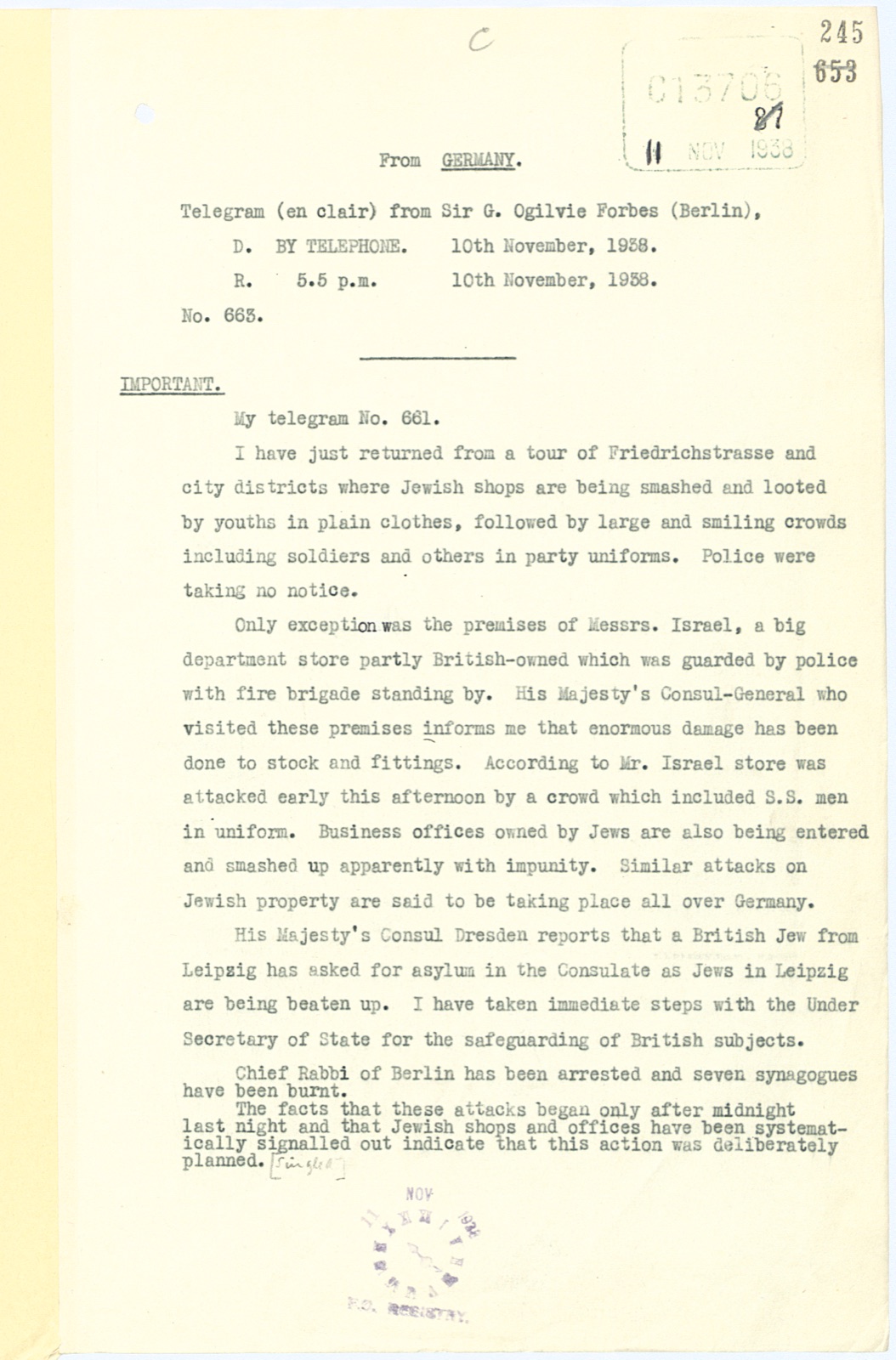
Jewish shops are being smashed and looted by youths in plain clothes, followed by large and smiling crowds including soldiers and others in party uniforms. Police were taking no notice.
Telegram No. 663 from Sir George Ogilvie-Forbes, Berlin, November 10, 1938. The National Archives, Kew, FO 371/21636. Contains public sector information licensed under the Open Government Licence v3.0. View the record: That afternoon, the British charge d'affaires in Berlin telephoned a
The method was written down too. An SA report from Darmstadt, quoted by the National WWII Museum, records the order its men were given: all the Jewish synagogues in their area, which the editor of the published document puts at about 700 square miles south of Frankfurt am Main, were to be "blown up or set on fire." It added that "Neighboring houses occupied by Aryan population may not be damaged," that the action was "to be carried out in civilian clothes," and that "Rioting and plundering are to be prevented."
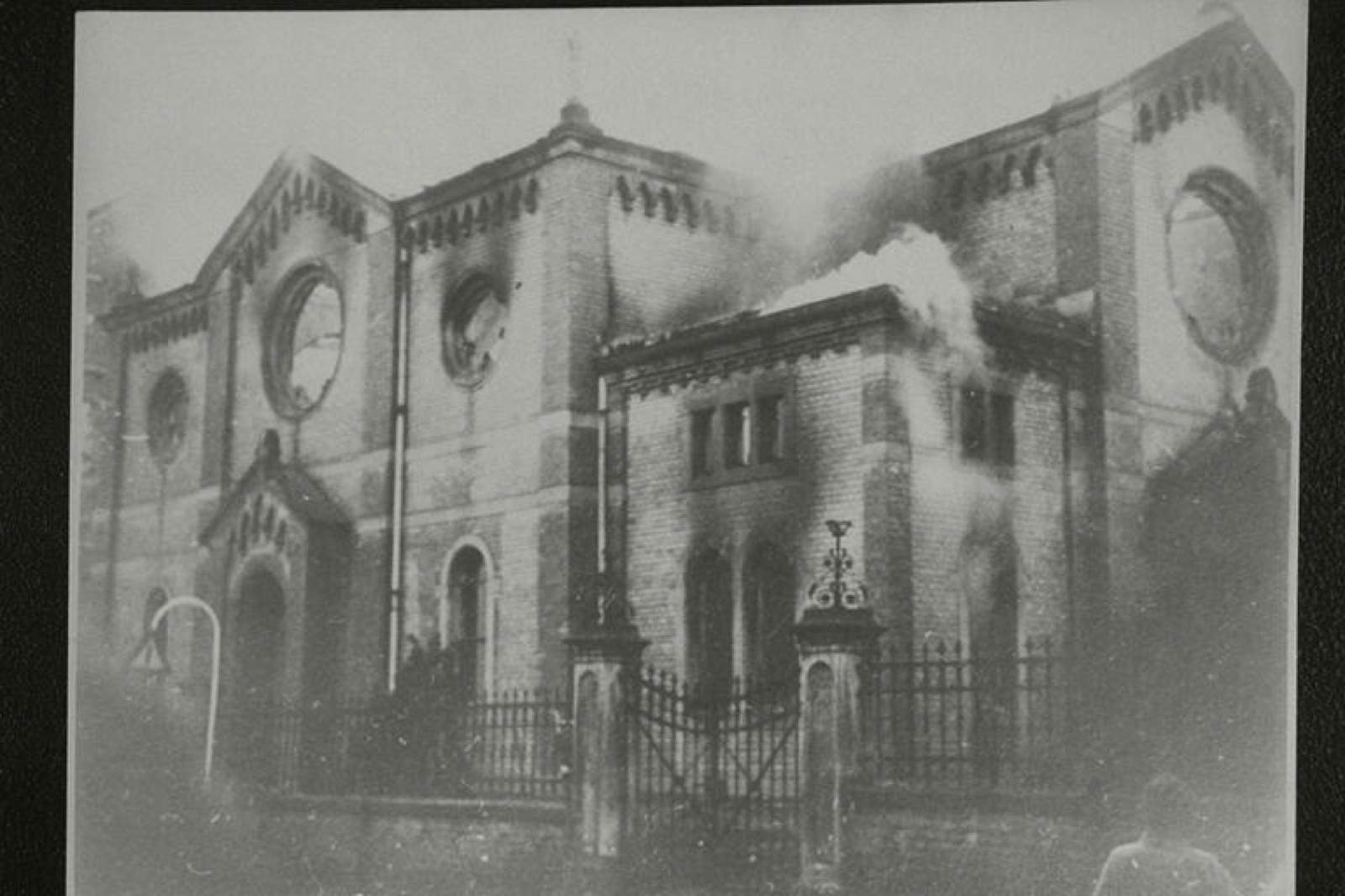
Photographer unknown · 1938-11-09 · Leo Baeck Institute, New York, published on Flickr Commons by Center for Jewish History, NYC, Call Number AR 3321 No known copyright restrictions; may be subject to third party rights. Flickr Commons usage: rights statement for The synagogue at Ludwigsburg in Wuerttemberg burning on November 9, View the record: The synagogue at Ludwigsburg in Wuerttemberg burning on November 9,
The synagogues burned in public. The Holocaust Memorial Museum records crowds of onlookers, Jews in some places made to clear the debris afterward, and schoolchildren in several towns brought to watch and to join in. Inside the buildings the destruction was aimed at what made them holy. Torah scrolls were thrown to the ground, torn, burned and thrown into rivers, and in some places the rabbi and members of the congregation were made to watch or to take part.
At half past nine on the morning of November 10, about fifty men arrived at the Jewish orphanage in Dinslaken. Thirty-two children and fifteen staff were inside. Yitzhak Herz, the teacher in charge, went to the local police and asked for protection.
We had just finished the morning prayers when we heard loud noises and screams. We ran outside to the courtyard. We heard the sound of things smashing. We listened in pain. It was raining. We stood there trembling... in the afternoon, they took us to some farm and put us in an abandoned cowshed with straw in the middle... They improvised something to eat... we were there for a few days... we slept on the straw.Baruch Tor, born Turteltaub, twelve years old at the Jewish orphanage in Dinslaken. He was the only member of his family to survive. Yad Vashem.
Jews do not get protection from us! Vacate the area together with your children as quickly as possible!The police captain of Dinslaken, answering Yitzhak S. Herz, who recorded the words. Herz wrote that the children then fled the house without hats or coats. Yad Vashem.
It was called off at four in the afternoon on November 10. Goebbels issued a statement over the radio ordering the whole population to stop, and saying that the answer to the shooting in Paris would now be delivered by way of legislation and edicts. Mob violence went on at least into the next day. He meant the second half of that literally.
Almost nobody Jewish was holding a camera that night
The photographic record of the pogrom was made almost entirely by people who were safe.
Every photograph you have looked at so far was almost certainly made by somebody who was safe. That is not a quirk of what happened to survive. It is the shape of the record itself, and a reader who does not know it will finish any page about Kristallnacht, this one included, having watched the night through the eyes of the people who organized it.
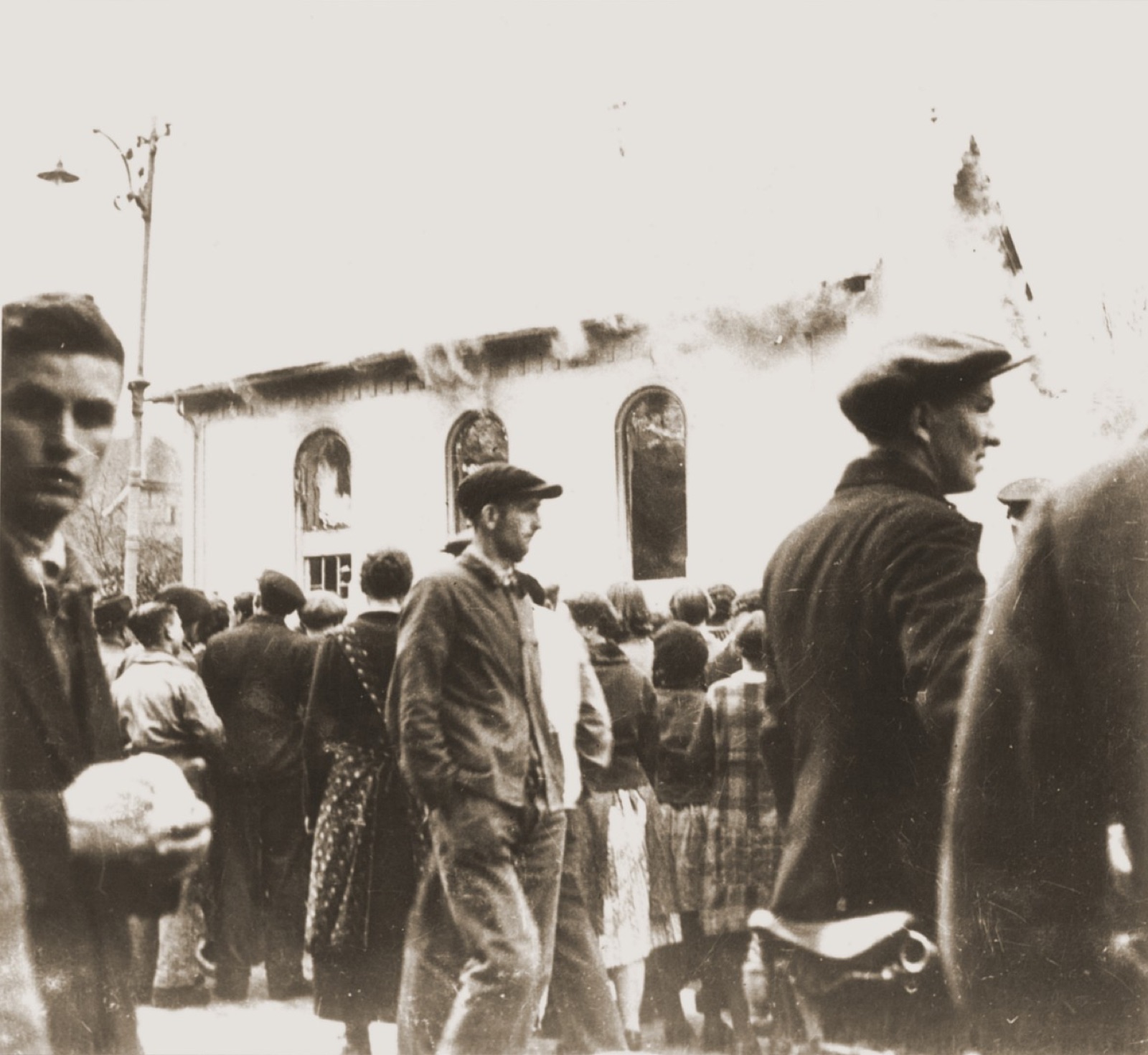
Photographer unknown · 1938-11-10 · United States Holocaust Memorial Museum, courtesy of Hessisches Staatsarchiv Darmstadt, USHMM pa1111175, holding archive reference R4/22502/3 United States Holocaust Memorial Museum View the record: Ober Ramstadt in Hesse, the morning of November 10, 1938. The
Count only the pictures. For this page that means the forty-three photographs and the one piece of film gathered out of archives, with Project Witness's filmed testimony and the typed documents set aside, because those are not what a reader looks at. Sixteen of the forty-three were made by Germans. Three show Jewish life rather than its destruction, and none of the three records who took it: the synagogue at Aachen standing whole with the inscription over its door, the sanctuary at Elsdorf with its seats in place, and Joseph Landman of Augsburg photographed in a studio before Dachau and again after.
Twenty-one of those forty-three cannot be traced to any maker, or even to a side. Across the full set of 106 items gathered for this page, twenty-five are filed the same way. Unknown is a filing decision and not a neutral result. About 30,000 Jewish men were arrested in the days after November 9 and many were marched through their own streets past their neighbors. German photographs went into German files and were captioned by the offices that made them, which is why they are still legible today. A picture taken by a Jew that week had to outlive the man who took it. The page files those twenty-one as unknown rather than guessing, and the reader should know which way the guess would run.
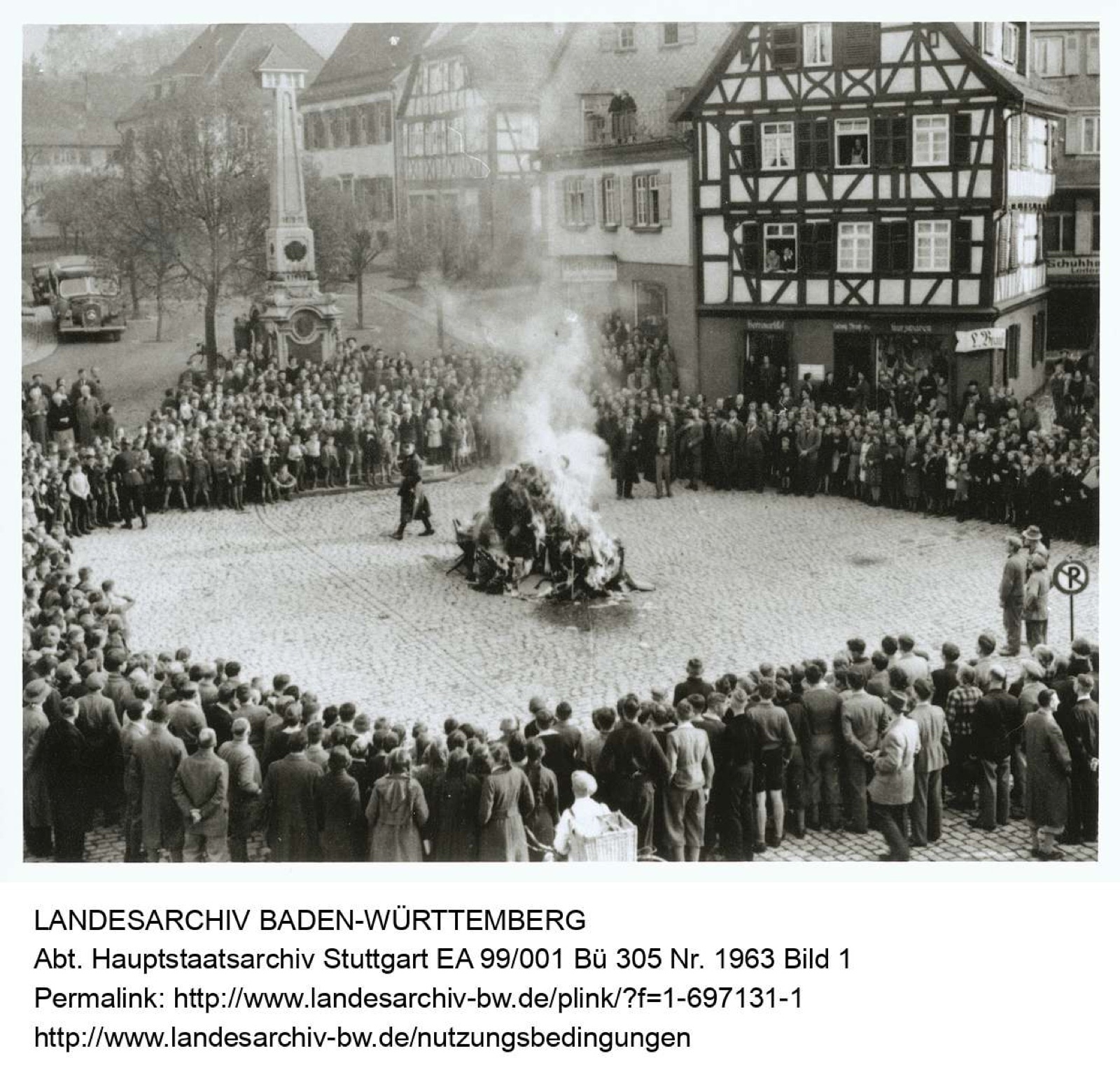
Photographer unknown. Rights holder recorded as the Mosbach public prosecutor · 1938-11-11 · Landesarchiv Baden-Wuerttemberg, Hauptstaatsarchiv Stuttgart, EA 99-001 Bue 305 Nr. 1963, EA 99-001 Bue 305 Nr. 1963 Bild 1, permalink id 1-697131-1 CC BY 3.0: licence for Mosbach, Friday November 11, 1938, the third day. Somebody wrote View the record: Mosbach, Friday November 11, 1938, the third day. Somebody wrote
One object in everything gathered here was made by a Jew while it was happening, and its authorship is beyond dispute. It is not a photograph. Gustav Straus, arrested on Kristallnacht, wrote a postcard to his wife and son in Essen on November 18, 1938, from the train taking him to Dachau.
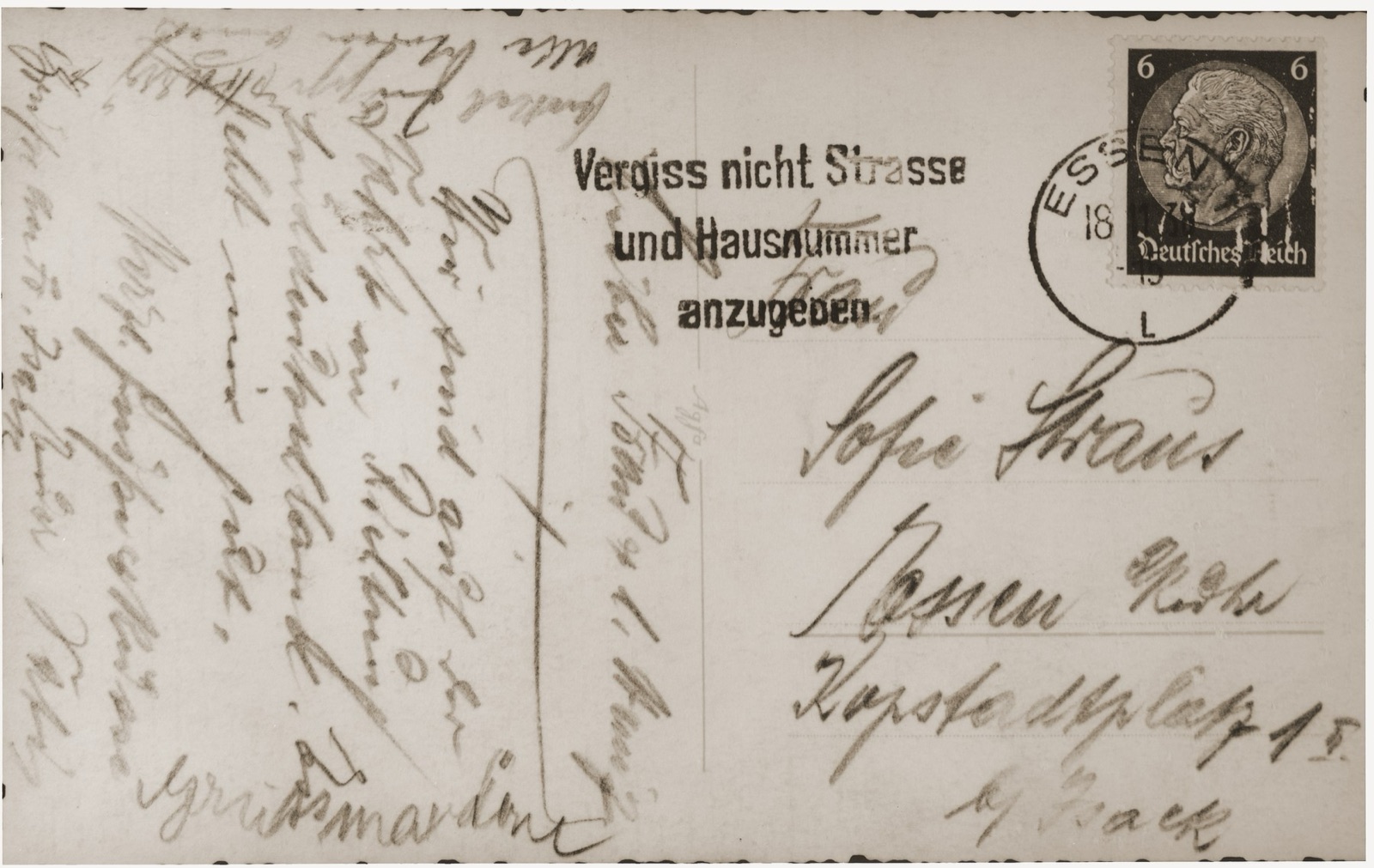
United States Holocaust Memorial Museum, courtesy of Henry Straus. View the record: He writes that they are traveling toward southern Germany and that he
The synagogue was attacked, all the windows were shattered, the pews were smashed, the curtain of the Ark torn into pieces and a Torah scroll thrown outside. The entire contents of the synagogue were destroyed, Torah scrolls were thrown to the ground and torn and three scrolls were removed together with the Ark. The black memorial plaques on the walls were smashed.Aharon Arnold Rosenfeld, Vienna, writing to his son Haim in Haifa a few days after the pogrom. Yad Vashem Archives.
That letter is a Jewish record of the same rooms, made within days, and it reads as an inventory rather than a lament. That is the form the Jewish record of that night mostly takes. It is written and it is spoken. Where there is no Jewish photograph of November 1938 there is a Jewish account of it, and Project Witness filmed those accounts and holds them. They come next, whole and free.
In their own words
Project Witness filmed these interviews and holds them. Each one opens in full in the film library, with no account and no charge.
Nothing below has been cut down to a usable quotation. A survivor talks for as long as she talked, and the passages that wander away from November 1938 and come back to it are still there, because that is what a testimony is.
Three people are heard on this page. Two were in Germany when it happened: a nine year old in a village about five kilometers from Wurzburg, and a girl in Mainz who says she was five going on six. The third, Moshe Teitelbaum, tells what happened to his family in Vienna.
Watch, 0:39:03 Free, no sign-up
One more testimony is linked elsewhere on this page rather than a second time here.
Kristallnacht in the Orthodox world
A German shul in 1938 was several rooms in one building. It was where the kehillah, the organized Jewish community of the town, prayed, learned, gathered and decided things, and the Hebrew names say so: beis hakneses, the house of assembly, beis tefillah, the house of prayer, beis medrash, the house of study.
Under Nazi rule it also became close to the only place where Jews in Germany were allowed to meet, and the evidence is not rhetorical. It sits in a she'elah, a question put to a rabbi for a ruling. Rabbi Yechiel Yaakov Weinberg, who ran the Hildesheimer seminary in Berlin, was asked whether a concert could be held inside a shul, because the authorities would not let Jews assemble anywhere else. He answered it as a question in halachah, in Jewish law.
Observant life had been narrowing for years before anything was set on fire. A law of April 21, 1933 required animals to be stunned by electric shock before slaughter. It never mentioned Jews and never mentioned shechitah, and it outlawed shechitah in Germany five and a half years before the pogrom. Butchers went on doing it in secret.
What burned inside was not furniture. The Holocaust Memorial Museum records that across Germany and the annexed territories Nazis destroyed Torah scrolls deliberately, throwing them down, tearing them, burning them, throwing them into rivers, and that in places the local rabbi and members of his community were forced to watch or take part.
In Wurzburg a student at the Jewish teachers seminary walked over and found the library out on the playing field.
I went to the Sandbergerstrasse and there I saw a sight that haunted me for a long time. The Sifrei Torah (Torah scrolls) and other Seforim (religious books) of the Library were piled high on the playing field in front of the Seminar and were burning fiercely. Director Jakob Stoll was held by his arms and forced to watch, surrounded by the wildly jeering crowd.Shammai Zahn, eighteen years old, a student at the Israelitische Lehrerbildungsanstalt in Wurzburg. Yad Vashem, Jewish communities, Wurzburg. Testimony published in Ottensoser M. and Roberg A., eds., ILBA Israelitische Lehrerbildungsanstalt Wuerzburg 1864-1938 by the Alumni of 1930-38, Huntington Woods 1982, pages 183 to 187.
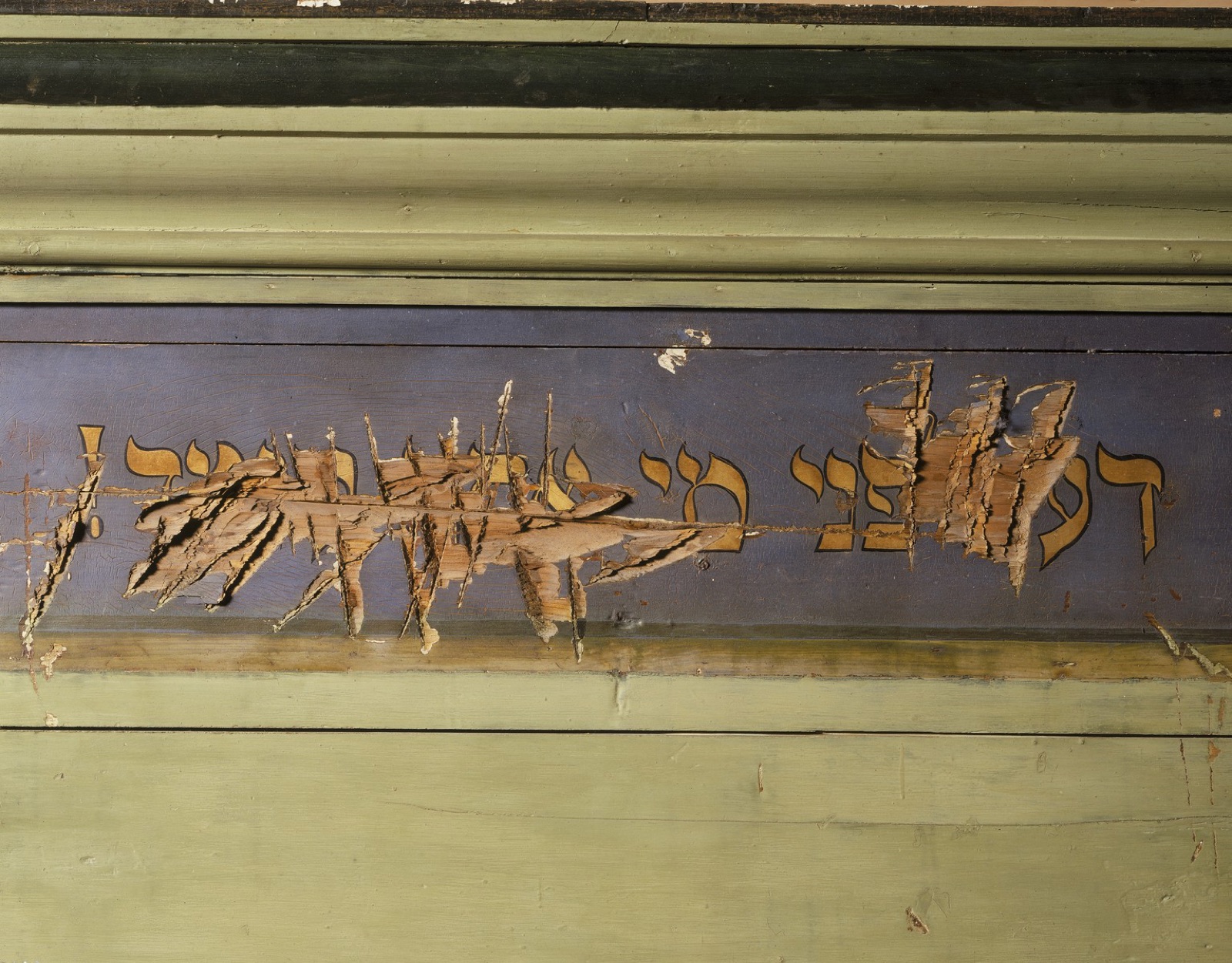
Arnold Kramer · n.d. · United States Holocaust Memorial Museum, courtesy of Juedisches Museum der Stadt Frankfurt, USHMM pa1091038, collections number IL91.005.001 United States Holocaust Memorial Museum View the record: The lintel from above the aron kodesh at Nentershausen in Hesse, from
Jewish law has a category for what was done in those rooms, and it is not property damage.
Moed Katan 26a lists the tears a person makes in his garment and never afterward mends properly: for a father, a mother, a teacher who taught him Torah, the Nasi, the head of the court; evil tidings; hearing G-d's name blessed, which is the euphemism the Gemara uses rather than say what it means; a burned sefer Torah; and the sight of the cities of Judea, the Temple or Jerusalem in ruins. It is a list of tears and not a list of mourners, and the tear stays in the garment.
For a sefer Torah the tear is doubled, one for the parchment and one for the writing, and the Shulchan Aruch widens it to tefillin and to a single scroll of the Prophets. It holds only where the scroll was destroyed by force. An accident does not trigger it. Somebody who meant to do it does.
The Talmud's picture of this is Rabbi Chanina ben Teradyon, wrapped by the Romans in the Torah scroll he had been teaching from, telling his students that he saw the parchment burning and the letters flying up.
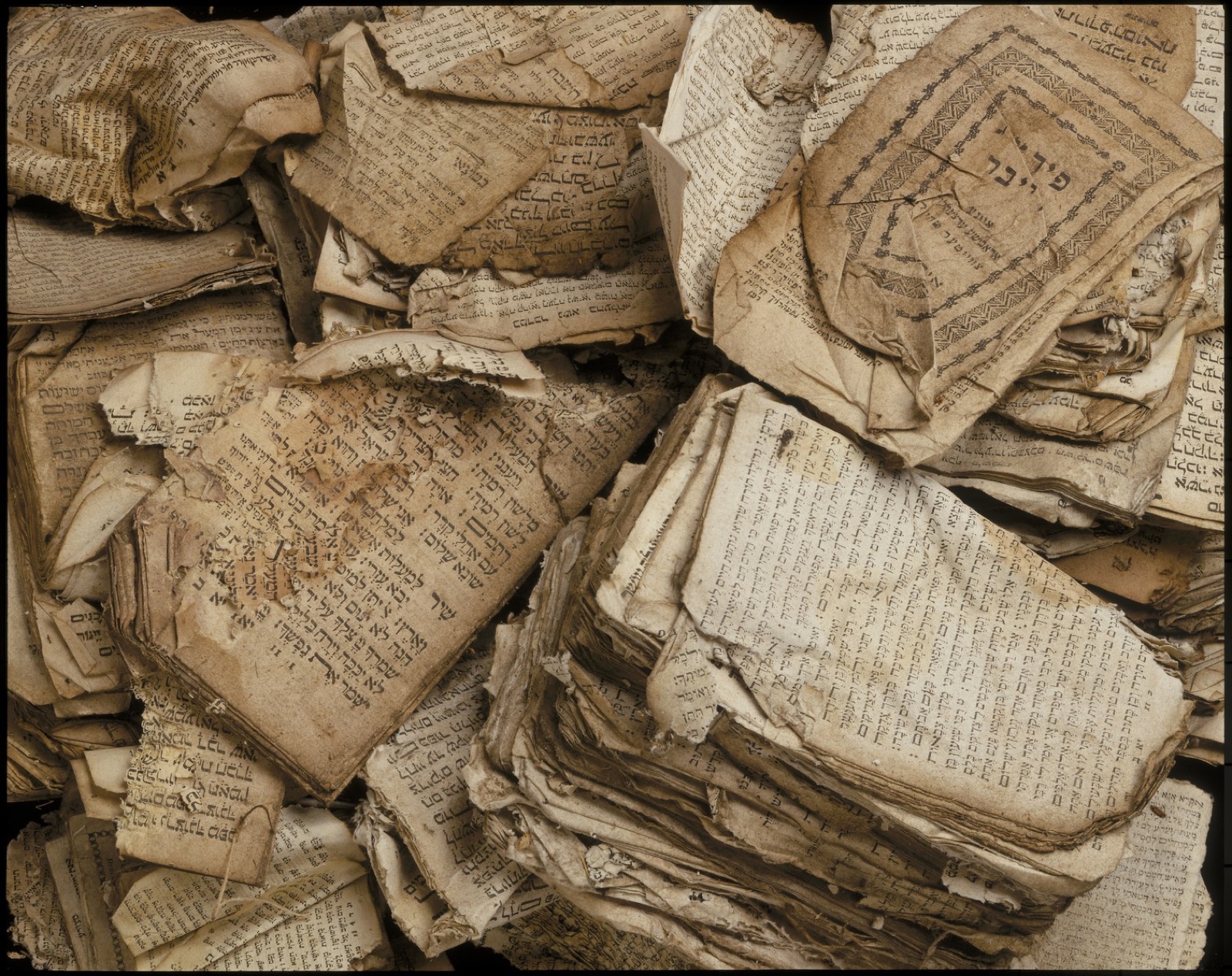
Arnold Kramer · n.d. · United States Holocaust Memorial Museum, courtesy of Jewish Community of Giessen, USHMM pa1091922, collections number 1989.236.1 United States Holocaust Memorial Museum View the record: Siddurim and seforim burned at the synagogue in Bobenhausen II in the
A shul does not stop being one when the roof comes off. The Mishnah rules that one fallen into ruin may not be put to ordinary use, and reads it out of a verse in Leviticus, I will bring desolation to your sanctuaries: sanctuaries stands after desolation, so the holiness stays on them while they are desolate. If grass comes up on its own in a ruined shul, the same passage adds, nobody should pull it out, because of the anguish it will cause those who see it.
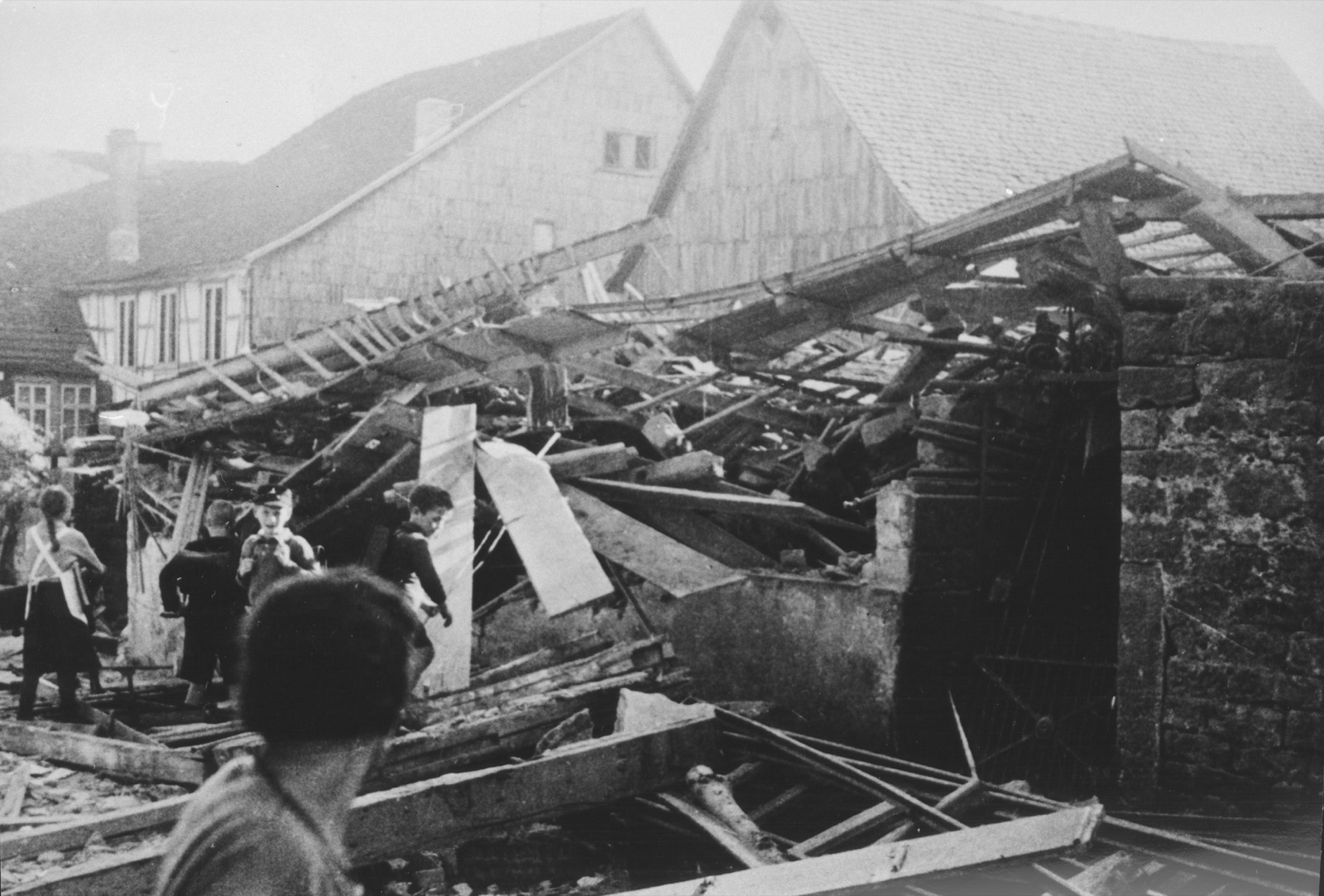
Photographer unknown · Circa 1938 November 11 · United States Holocaust Memorial Museum, courtesy of Stadtarchiv Beerfelden, USHMM pa1137046 United States Holocaust Memorial Museum View the record: German children play among the ruins of the Peter-Gemeinder-Strasse
People got things out.
In Ansbach, shortly before the pogrom, the police chief called in a friend named Ludwig Dietenhofer and told him what was coming. Dietenhofer went to the shul and took out the sefer Torah his family had donated, still bound with a wimpel given in 1840. A wimpel is the cloth a baby boy is swaddled in at his bris; in many German kehillos the family gave it to the shul when the boy turned three, to bind a Torah scroll, embroidered with his name and his father's. Many arks in Germany held a shelf of named children.
In Bad Ems the kehillah left all its scrolls with Rabbi Eliyahu Laupheimer's family, and when they fled at night after the pogrom the rav carried a small one on his person. In Leipzig, hours before it started, an anonymous caller from Stuttgart warned Chaim Israel that every synagogue in Germany was to be attacked. His congregation moved about a dozen scrolls out of the Broder synagogue into a building held by the Jewish National Fund, legally British property, and left one in the ark so people could still daven. That account reaches Yad Vashem at second hand. Sixty years on, renovators at the University of Leipzig library found Torah scrolls between the roof beams. Yad Vashem thinks it likely they are the scrolls Chaim Israel's congregation saved, and says it is still unclear how they reached the roof. One went to Yad Vashem; the rest were buried in the Leipzig Jewish cemetery, as holy books that can no longer be used are buried.
Two brothers in Mannheim pulled the cantor's choir book out of the debris of the Klaus Synagogue and returned it to his family fifty years later. Two scrolls desecrated that night are in Washington, retrieved by Germans who kept them safe until the war was over.
Three of the central institutions of German Orthodox education ended in 1938: the Hildesheimer Rabbinical Seminary in Berlin; the Israelitische Lehrerbildungsanstalt in Wurzburg, which since 1864 had trained teachers for Jewish elementary schools and, at the same time, chazzanim; and the Torah Lehranstalt in Frankfurt, founded in 1893 by Rabbi Solomon Breuer for the seceded kehillah there, the Israelitische Religionsgesellschaft built in the tradition of Rabbi Samson Raphael Hirsch. The Frankfurt kehillah's own building on the Friedberger Anlage was destroyed in November 1938.
SA men came into the Wurzburg dormitory that night, pulled the students out of their beds and beat them, then gutted the building while local people cheered. A student telephoned the police. The police came and arrested the older students, and the crowd cheered that too. Rabbi Jacob G. Wiener, then a student there, was woken at half past two and marched five abreast through the cobbled streets past burning synagogues while people spat at the boys. About fifty were arrested. He was held seven days. His mother was murdered in Bremen the same night.
Weinberg left in 1939 without his library and without his manuscripts, and called his collected responsa Seridei Esh, remnants of the fire, meaning himself.
Two last things. The first is from the Wurzburg town prison during the Polenaktion, six men to a cell. Friday came anyway.
And so Shabbos came. We davened as best we could and had something to eat. The food pushed under the door by the prison warden was, apart from being non-Kosher, quite inedible, and was returned untouched. Late Friday night we suddenly heard whistling from outside. Some of our Chaverim (friends) must have found out where we were, and whistled one of the tunes usually sung for "L'cho Dodi" at the Seminary.Shammai Zahn, Wurzburg town prison, Friday night, October 28, 1938. The published text heads the passage 28th October 1939, which is an error for 1938; the year has been corrected here. Yad Vashem, Jewish communities, Wurzburg, from the ILBA alumni volume, Huntington Woods 1982, pages 183 to 187.
Shammai Zahn was eighteen in both of those places, on the Sandbergerstrasse in front of the fire and in the cell hearing the whistling. He helped found the Sunderland Yeshiva in England in 1946 and led it as rosh yeshiva from about 1949 until his death in 2001.
The second was written eighteen years after the fire. Weinberg was asked a question in halachah about seforim saved from the library of the Berlin seminary. He answered it, and near the end of the answer he stopped to say this.
Regarding my personal library in the beit ha-midrash and in my room, I was not able to save a single book. I mourn for the loss of my books, since I left the valley of destruction barren and lacking everything.Rabbi Yechiel Yaakov Weinberg, 1956, in a responsum on seforim saved from the library of the Berlin Rabbinical Seminary. Yeshivat Har Etzion, Israel Koschitzky Virtual Beit Midrash, The Life of R. Yechiel Yaakov Weinberg.
It was not the first thing he wrote. He had opened the same teshuvah with the verse he said was fulfilled in him, Tehillim 118:18, G-d afflicted me but He did not give me over to death, and with the line from Eichah 3:39, why should a living man complain. It is enough, he wrote, that he is alive.
How many synagogues, how many killed
Four headline figures, four different things being counted, and how to tell which one you are reading.
Two figures circulate for the synagogues, and the smaller one is not a lower estimate of the same thing. It counts a different set of buildings.
The 267 comes out of a single sentence. Heydrich's express letter to Goering on November 11, 1938 reported 191 synagogues set on fire and another 76 completely destroyed, and someone added the two. The same sentence counts 11 parish halls and cemetery chapels burned and 3 more destroyed, and those fourteen buildings drop out almost every time the arithmetic is done. At Goering's conference the next morning the minutes record him giving 101 burned rather than 191, and nobody in the room reconciled it. 191 and 76 make the figure institutions have published for decades; 101 and 76 make 177, which nobody publishes. That is a reason to trust the written report over the minutes and no reason to pretend the two agree.
More than 1,400 counts synagogues together with prayer houses and the small rooms a kehillah davened in, and most of the distance between the two figures is that room, which is the institution the section above is about. The gap is not a quarrel among historians. It is the difference between what German police stations telephoned to Berlin inside a day and a half and what forty years of local work found afterward, town by town. The Synagogue Memorial in Jerusalem, whose memorial books document those buildings town by town, was begun in 1985 by Meier Schwarz, a boy in Nuremberg on the night it counts.
The extent of the destruction of Jewish shops and houses cannot yet be verified by figures. The figures given in the reports, 815 shops destroyed, 29 department stores set on fire or destroyed, 171 dwelling houses set on fire or destroyed, indicate only a fraction of the actual damage caused, as far as arson is concerned. Due to the urgency of the reporting, the reports received to date are entirely limited to general statements such as 'numerous' or 'most shops destroyed.' Therefore the figures given will be considerably augmented.
One hundred and ninety-one synagogues were set on fire and another 76 completely destroyed. In addition, 11 parish halls, cemetery chapels, and similar buildings were set on fire and three more completely destroyed.
Express letter from Reinhard Heydrich, Chief of the Security Police, to Minister President Field Marshal Hermann Goering, subject: Action against the Jews, November 11, 1938, file reference II B 4-5716/38 g. Nuremberg document 3058-PS, exhibit USA-508. English text as read into the record of the International Military Tribunal on January 2, 1946, Trial of the Major War Criminals, volume IV, page 278, from the Avalon Project. Public domain. View the record: Heydrich's express letter to Goering, November 11, 1938, file
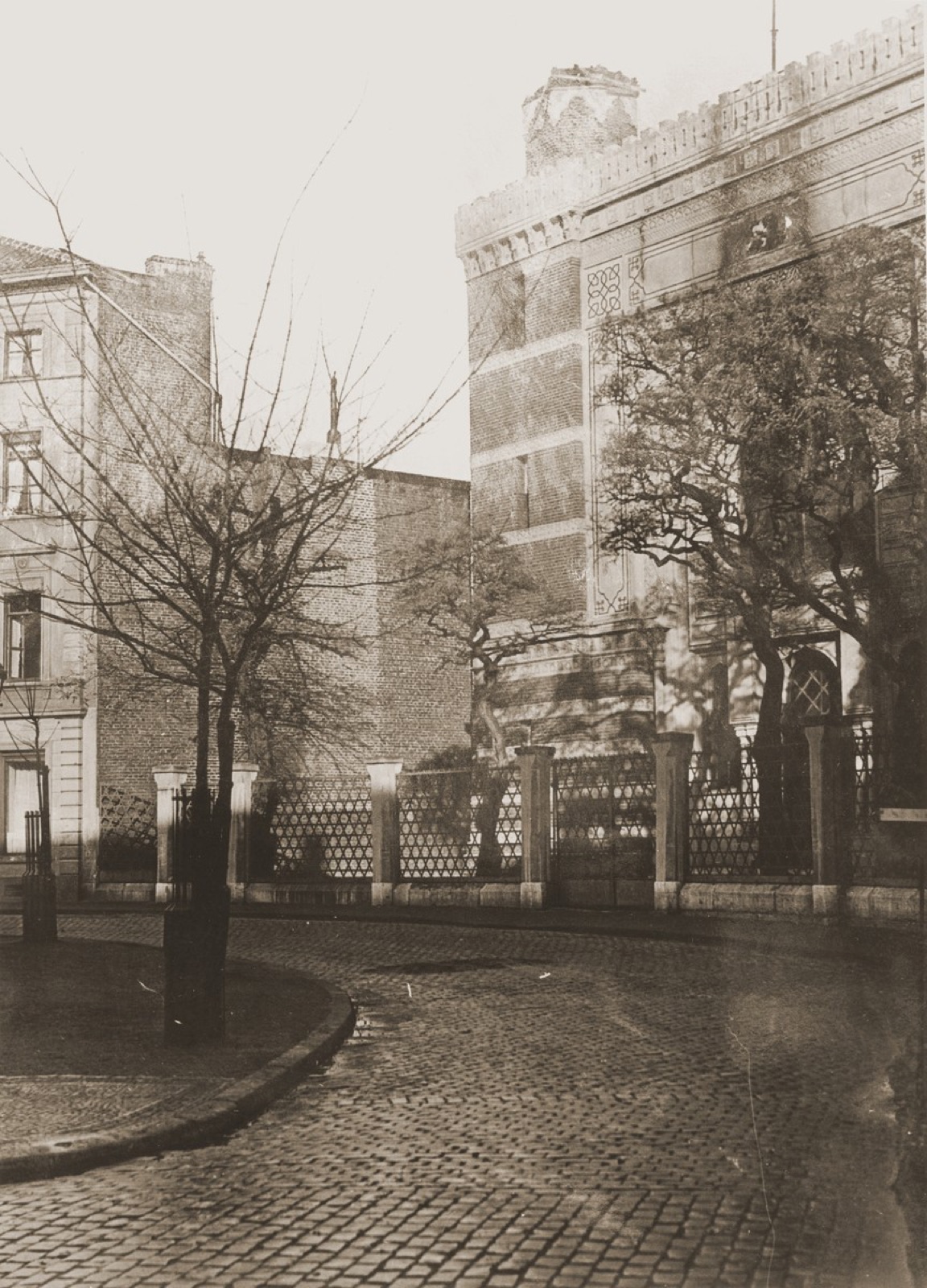
Photographer unknown · Before 1938 · United States Holocaust Memorial Museum, courtesy of Stadtarchiv Aachen, USHMM pa1117978, holding reference 'Abb. 203a' United States Holocaust Memorial Museum View the record: The synagogue in Aachen, built in 1862. Cut over the portal is Isaiah
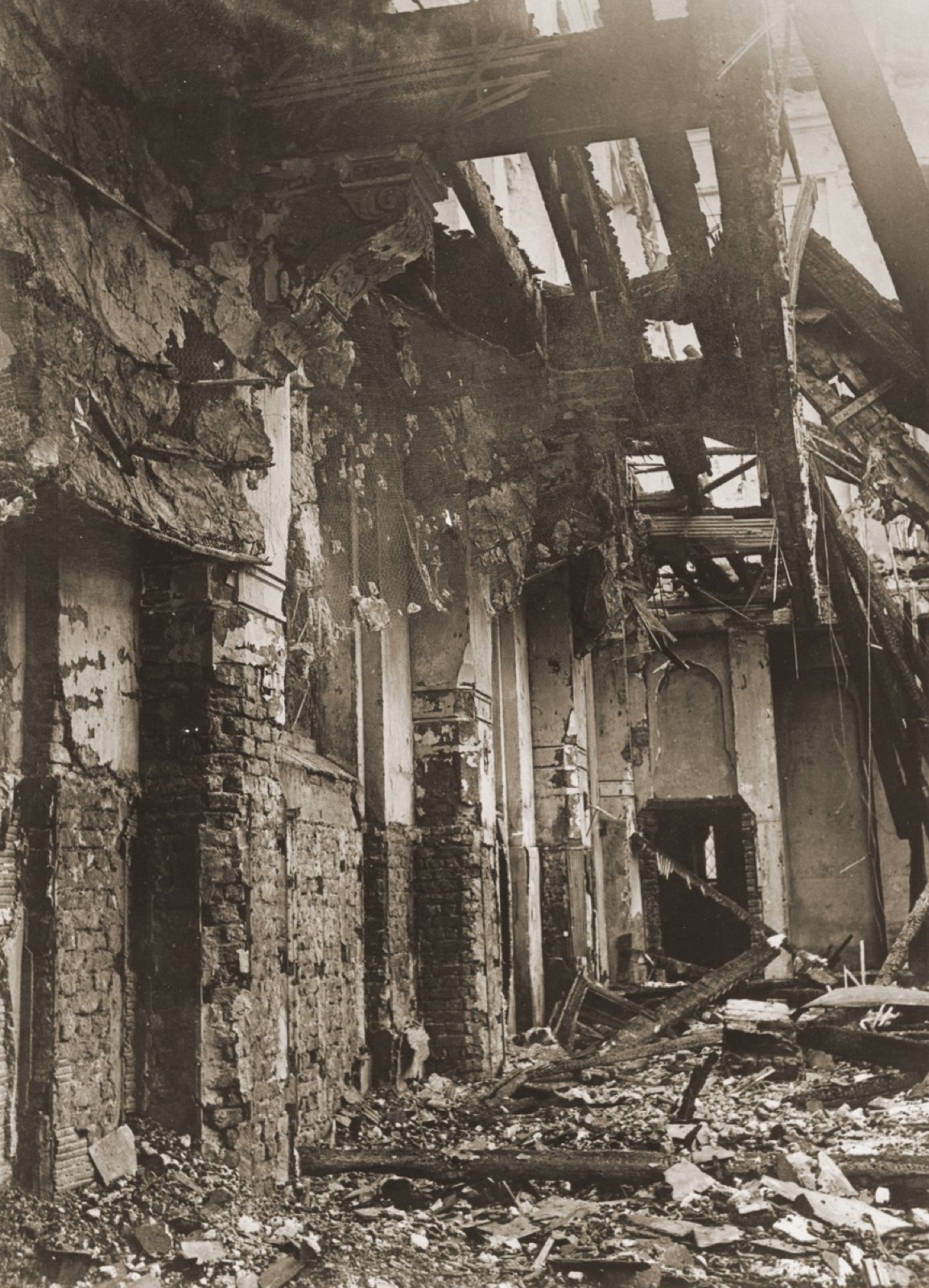
Photographer unknown · Circa 1938 November 10 · United States Holocaust Memorial Museum, courtesy of Stadtarchiv Aachen, USHMM pa1117979 United States Holocaust Memorial Museum View the record: The same building around November 10, 1938, after it was burned. The
The dead were counted three times by the men who killed them, and the number rose each time. Goebbels wrote seventeen in his diary on November 11 and wrote beside it that no German property had been damaged. Heydrich reported thirty-six to Goering the same day, with thirty-six seriously injured and one Jew missing. Three months later the Nazi Party's own Supreme Court told Goering that police investigations into the other killings, "all together 91," had not been concluded, and attached its rulings in sixteen cases it had already closed.
Every 91 in print traces back to that line. It counted open files inside a perpetrator's own disciplinary system, it was never independent of the men it counted, and the court that produced it expelled none of the killers, on the reasoning that they had understood what the leadership wanted. The same report records, on the word of the deputy Gauleiter of Munich-Upper Bavaria, what Goebbels said when the first killing reached him at about two in the morning on November 10: the informer should not get excited about one dead Jew, that in the next few days thousands of Jews would perforce see the point.
So 91 leaves out anyone who died in custody, anyone who died later of what was done to him, and everyone who killed himself. Count those and the modern figures separate. The Holocaust Memorial Museum writes hundreds twice, once for deaths and once for suicides, and prints no numeral anywhere. Yad Vashem gives hundreds on one page and 91 on two others, and says plainly that the exact numbers vary depending on the research. The Jewish Museum Berlin gives approximately 400 murdered or driven to suicide. Angela Hermann's 1,300 to 1,500, for those days and the weeks after, is the top of the published range.
This page prints hundreds, and says which hundreds: people killed during the pogrom, men who died at Dachau, Buchenwald and Sachsenhausen in the weeks that followed, deaths from injuries and from shock, and suicides. That is the formulation the Holocaust Memorial Museum has moved to and the one Yad Vashem's main page points toward, and the only one that does not ask the page to pretend the record is better than it is.
One category of the violence has no figure at all, and it is in the record all the same. Rape was part of what was done in November 1938. Yad Vashem names it, setting it beside the murders and the arrests when it lists what happened in those days, and the Holocaust Memorial Museum records documented cases of sexual assault on the night of November 9 and 10. Neither institution publishes a number. No perpetrator document quoted on this page produces one either.
The party court's own report shows why. Alongside the cases still under police investigation it carried sixteen the court had already ruled on, and three of those sixteen were not killings. Two were sexual crimes, one of them against a girl of thirteen, and one was theft. This was a disciplinary body, and that is what each of the sixteen was tried as. Take one case from the report's list: a party member who had killed a Jewish husband and wife was given a warning and barred for three years from holding public office, and what the court entered against him was a disciplinary violation, namely the killing of the couple contrary to orders. The Holocaust Memorial Museum's account of the prosecutions that did follow is that some men were punished for sexual assault and that most of the sentences were light.
So the four figures at the head of this section are not a measure of the night. They are a measure of what the offices of the time were willing to count, and this is the category those offices were least willing to count. A missing number is evidence about the record and not about the event.
Every figure above is a total. This is one of the people inside one, on paper written by the government that killed her.
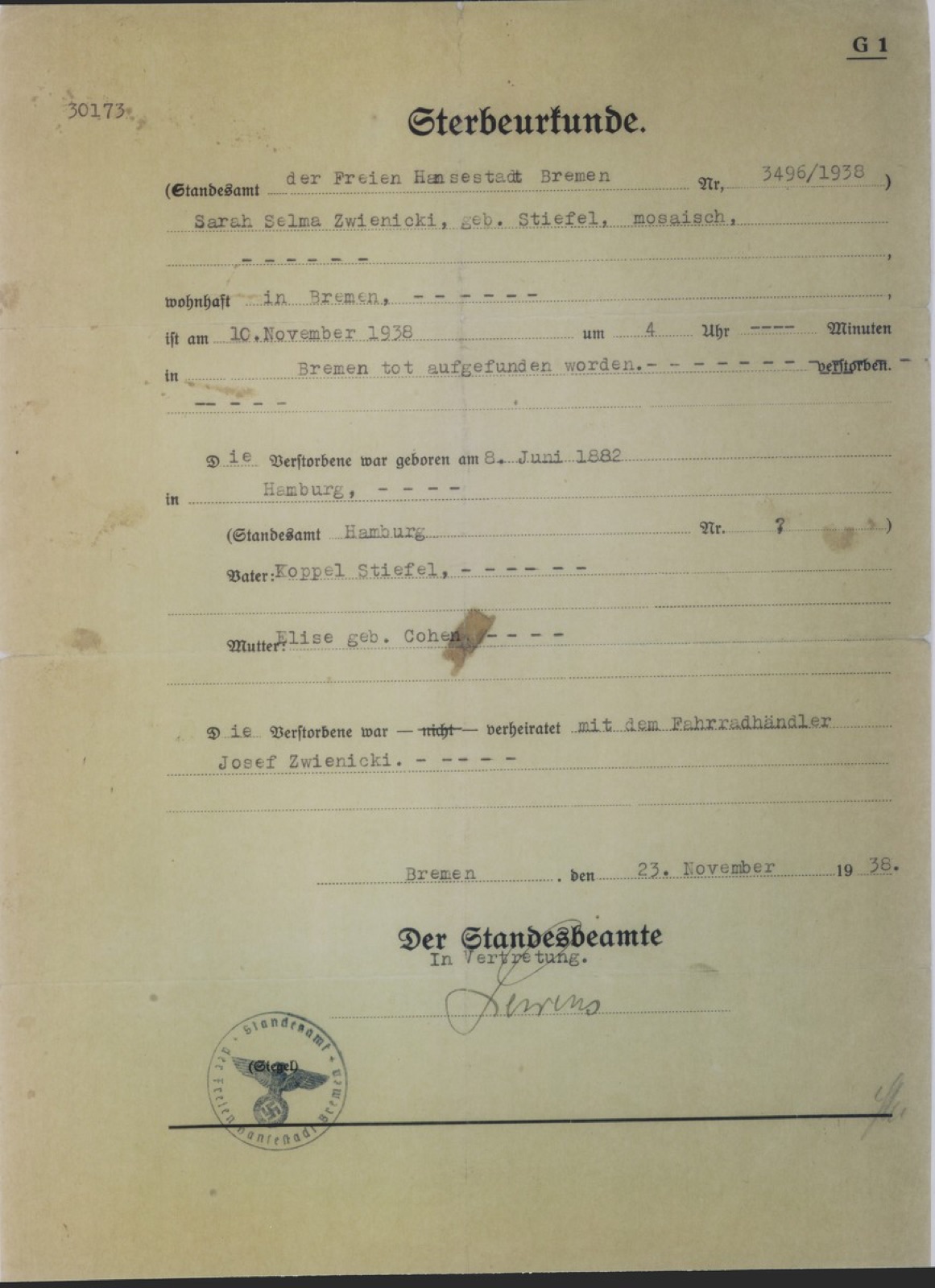
United States Holocaust Memorial Museum, courtesy of Jacob G. Wiener. View the record: Selma Stiefel Zwienicki, born in Hamburg on June 8, 1882, married to
Vienna is where the split between a synagogue and a prayer room is documented most plainly. About 100 synagogues and houses of prayer served the city's Jews on the eve of the Holocaust; the City of Vienna counts 24 synagogues and 78 prayer houses. Yad Vashem says few survived. The city's own history adds that nearly all the large synagogues and numerous prayer houses were plundered and set on fire, and the Documentation Centre of Austrian Resistance counts 42 synagogues and prayer houses burned, destroyed or devastated.
One building came through, and the reason is an old building rule. Vienna's regulations barred non-Catholic houses of worship from showing themselves on the street, so when the Stadttempel went up between 1824 and 1826 it was built inside a block of houses. In 1938 that meant it could not be burned without burning the houses attached to it, and the order governing the fires that night had drawn its one line exactly there. It was not spared. Yad Vashem's own Vienna album records SS men beside it and its interior badly vandalized, and Aharon Rosenfeld, writing to his son in Haifa within days, says a fire was started inside it. The building survived because of the walls it was touching.
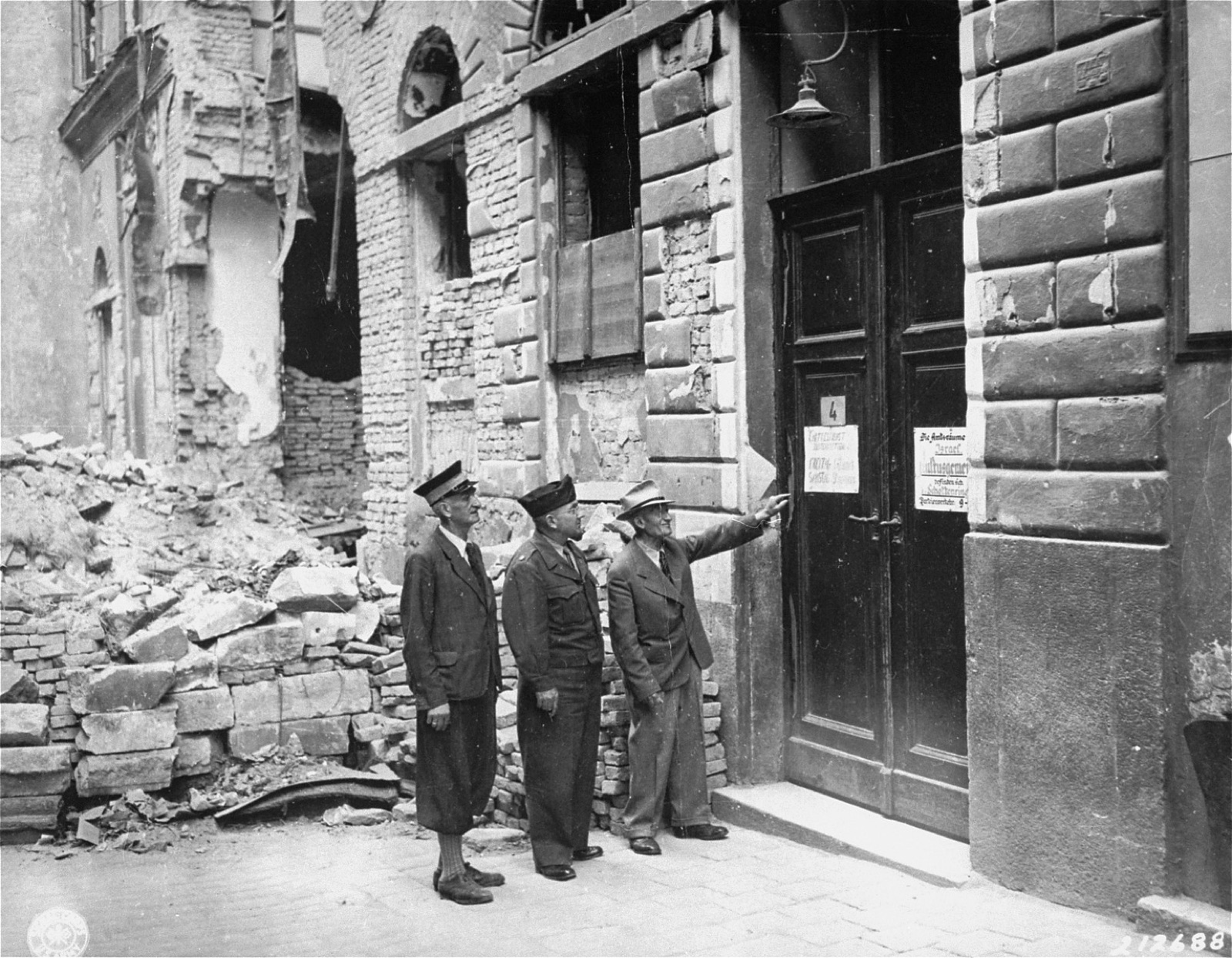
United States Army Signal Corps · 1945 or 1946 · United States Holocaust Memorial Museum, courtesy of Paul Grisso, USHMM pa30949, Signal Corps number 111-SC-212688 United States Holocaust Memorial Museum View the record: The synagogue at 4 Seitenstettengasse, photographed by a United
What happened next
The arrests, the camps, and the six weeks of law that finished what the night began.
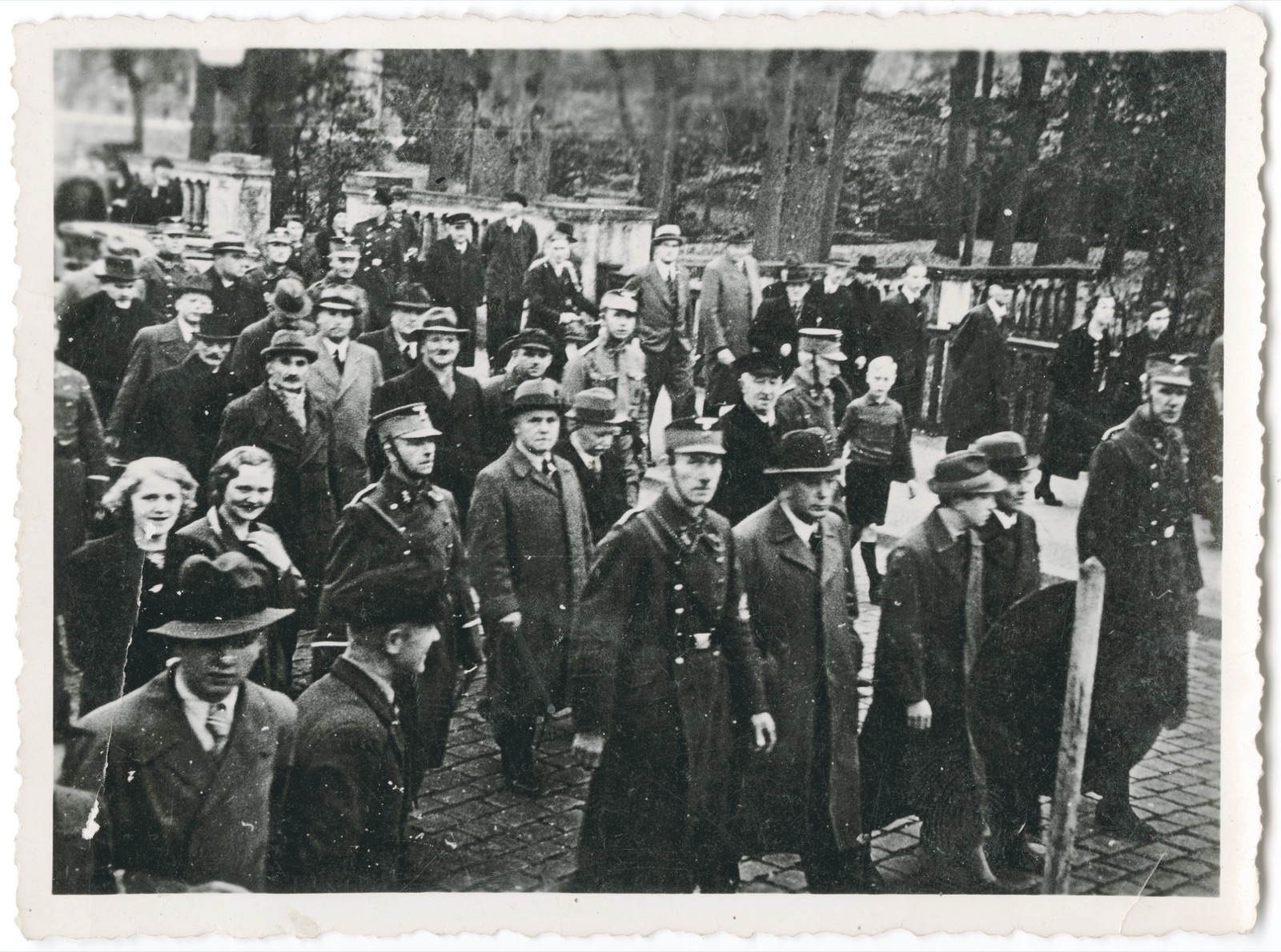
Photographer unknown · November 1938 · United States Holocaust Memorial Museum, courtesy of Abraham Levi, USHMM pa1175949 United States Holocaust Memorial Museum View the record: Oldenburg, November 1938. Jewish men of the town under SA escort,
The arrest order had gone out before most of the synagogues were lit, and by the morning of November 10 the police were working through it. About 30,000 Jewish men were arrested. Around 26,000 of them reached Dachau, Buchenwald or Sachsenhausen; the rest were held in local prisons and police stations and released without ever seeing a camp. That split is the Holocaust Memorial Museum's. Most others still publish one figure of about 30,000 sent to camps. It was the first time the regime imprisoned Jews on a mass scale for no reason other than that they were Jews.
Almost 11,000 men were interned at Dachau on November 10 and 11. The Gestapo brought 9,845 to Buchenwald and penned them in a fenced special camp beside the roll call square. About 6,000 went to Sachsenhausen. The camps had not been built for numbers like that, the men were held in overcrowded and filthy conditions, and hundreds died of the way the SS treated them. The Buchenwald memorial counts 250 dead in its own special camp; Yad Vashem puts it at 600. There is no comparable count for the other two.
Most of the men came home after several weeks. Release was usually conditional. Prove you were leaving, or in some cases sign the business over. Their wives, mothers and other relatives often confronted the authorities to help win their release.
They came at 2:30 at night... And they walked us through the street, and while they were walking us through the street, these people, you see, called us names, they spit at us, and so forth.Rabbi Jacob G. Wiener, a student at the teachers seminary in Wurzburg, on the arrest of about fifty students from their dormitory. United States Holocaust Memorial Museum, First Person podcast, March 25, 2009.
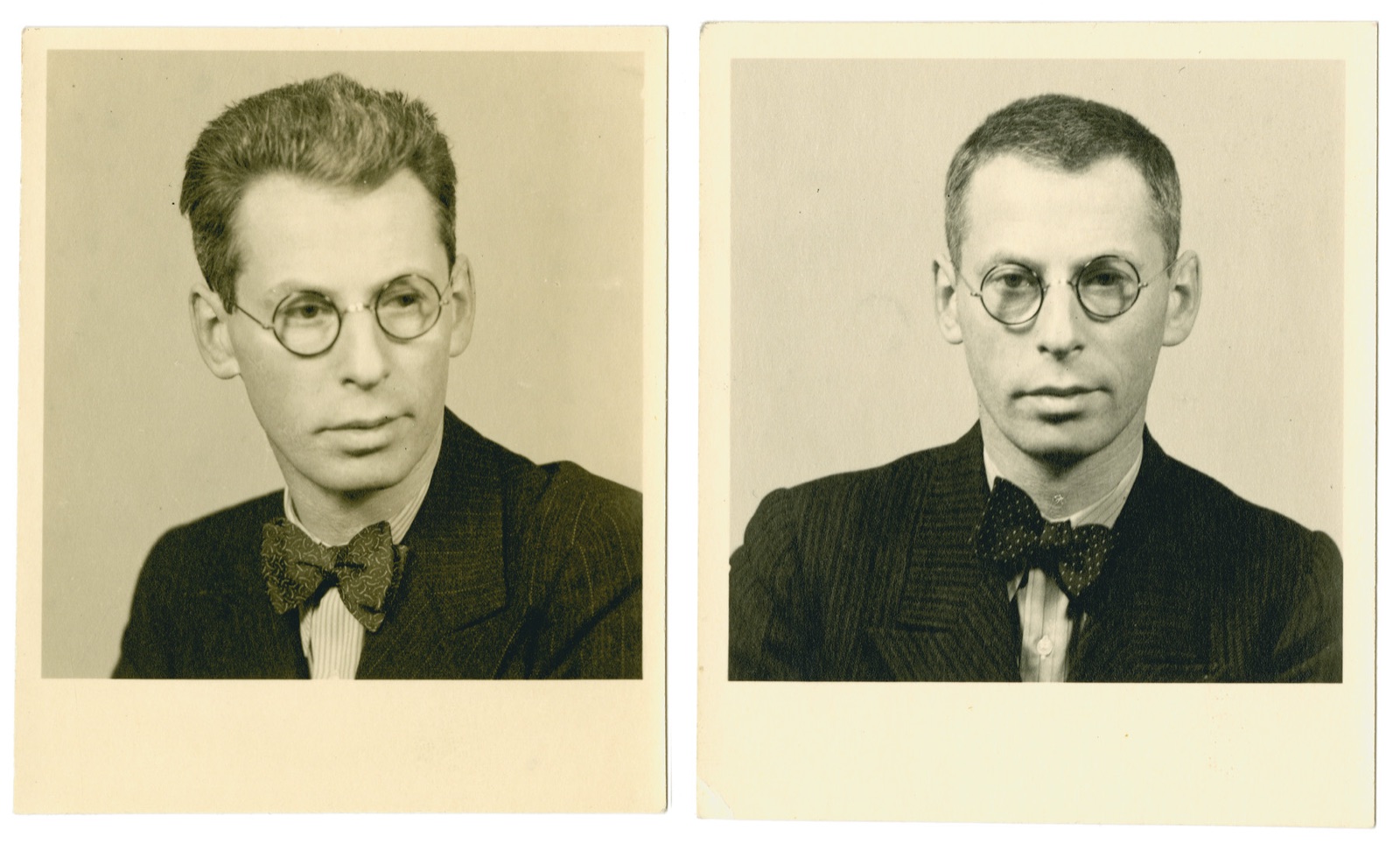
Studio photographer unrecorded · 1938 · United States Holocaust Memorial Museum, courtesy of Henry Landman, USHMM pa1177679, collections number 1999.A.0175 United States Holocaust Memorial Museum View the record: Joseph Landman of Augsburg, photographed in a commercial studio in
On November 12, Hermann Goering called more than a hundred people to the Reich aviation ministry in Berlin: ministers, party officials, industrialists and the men who ran Germany's insurance companies. The subject was the damage. What was criticized in that room was the property, not the dead.
The insurance problem was solved inside the meeting. Hilgard, speaking for the insurers, put the glass alone at a sum the Nuremberg translation renders as six million dollars, about half a year of Belgian plate glass production and roughly twice a normal year's claims. German insurers were liable, and refusing to pay would have cost the industry its standing abroad. Heydrich proposed that the claims be paid and the money then confiscated. Goering agreed, and the money went to the state.
Stenographic report of the meeting on the Jewish question under the chairmanship of Field Marshal Hermann Goering, Reich Air Ministry, November 12, 1938, 11 o'clock. Nuremberg document 1816-PS, exhibit USA-261, printed in Nazi Conspiracy and Aggression, Volume IV (Washington: United States Government Printing Office, 1946). English text from the Avalon Project, Lillian Goldman Law Library, Yale Law School. Public domain, a work of the United States government. View the record: The stenographer's record of the meeting under Goering at the Reich
The insurance may be granted, but as soon as it is to be paid, it'll be confiscated. That way we'll have saved face.Reinhard Heydrich to the meeting, with Goering answering that the money belonged to the state and that the Jew would report the damage, get the refund from the insurance company, and have the refund confiscated. Stenographic minutes, Nuremberg document 1816-PS.
The fine was one billion Reichsmarks, announced as an atonement payment for what the decree called Jewry's hostile attitude toward the German people and Reich. An implementing order nine days later turned that sum into a rate. The Jewish Museum Berlin gives the terms: 20 percent of the assets of every Jew of German nationality and every stateless Jew holding more than 5,000 Reichsmarks, payable in four installments from December 15, 1938. Four installments did not produce the billion, so a fifth of a further five percent was added in 1939. It was often deferred, sometimes more than once, but never waived, and demands went out even to people who had already emigrated. The payments in the end exceeded the billion that had been demanded.
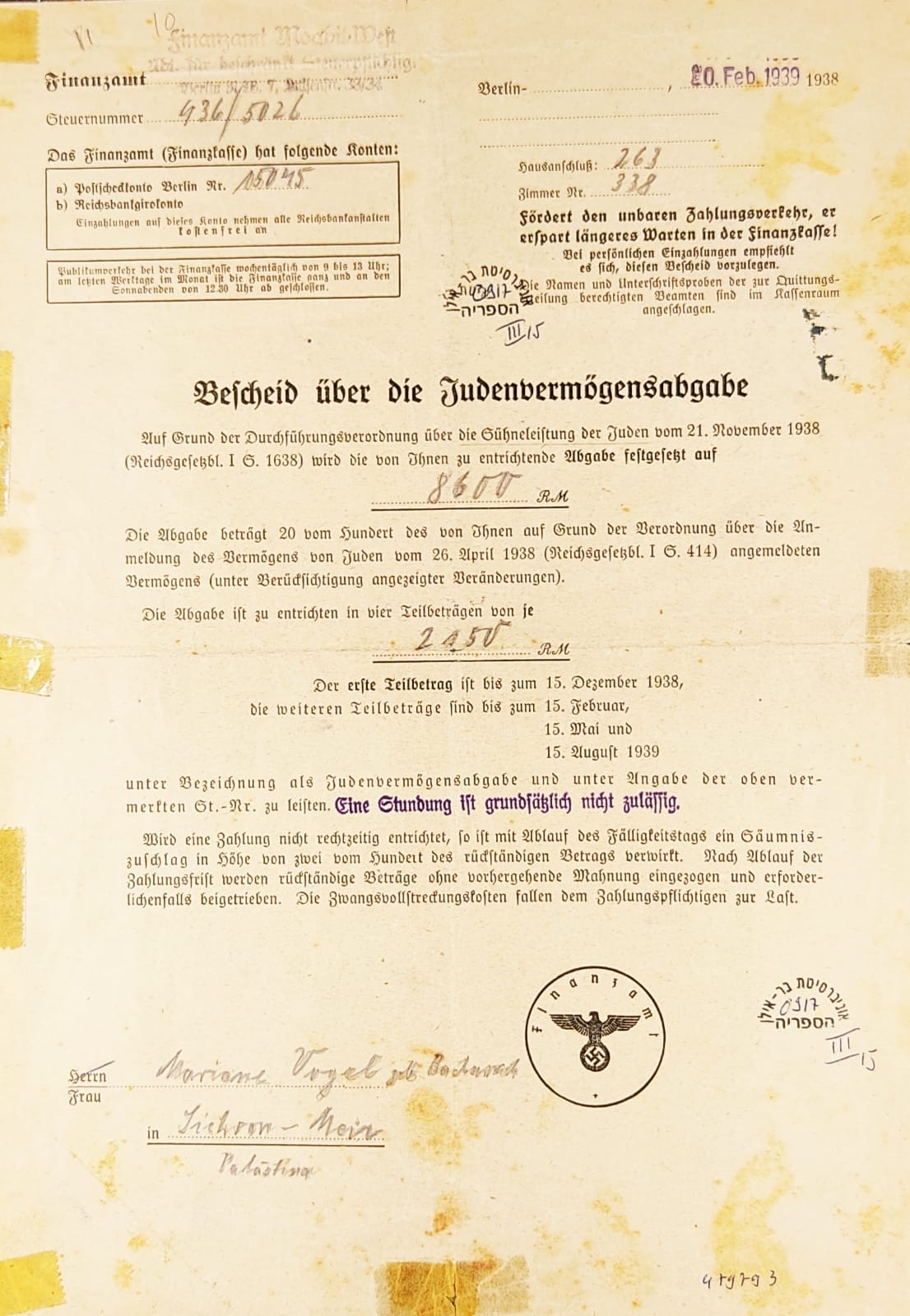
Demand for payment of the fine imposed on German Jews after the November 1938 pogrom, addressed to Mariane Vogel, February 20, 1939. Isaac-Yitzhaki family documentation, manuscript 0917, Bar-Ilan University Libraries and Information Systems. Public domain, work of the German government. View the record: A demand for payment sent to Mariane Vogel on February 20, 1939 for
The rest was done by law, and it took about six weeks.
November 11: Jews had to surrender firearms and bladed weapons to the police, without compensation. November 12: three decrees on one day. The first demanded the billion. The second, on the restoration of the streetscape, made Jewish owners pay to repair the damage done to them and seized their insurance claims for the state in one sentence. It also dated the damage it covered to November 8, 9 and 10, which is three days and not one night. The third barred Jews from shops, mail order businesses and independent crafts from January 1, 1939.
November 15: Jewish children were put out of German public schools, and the order gave the shooting in Paris as its reason. Over the next three weeks welfare was cut back, every Jewish newspaper but one was closed, officials were given the power to decide when and where Jews could appear in public, and the authorities were empowered to force the sale of Jewish businesses and land. Jews had to deposit their securities in designated banks and were barred from buying, selling or pawning jewelry, gold, silver and art.
On November 19 the Ministry of Justice quietly told prosecutors not to pursue the property cases. Arson, housebreaking and vandalism were all crimes under German law, and the police had been ordered not to intervene while they were being committed. Most of the cases were dismissed. The decrees between them left almost no part of German economic or social life open to a Jew. The purpose was to make them leave and to keep what they left behind.
Getting out, and the doors that stayed shut
One family's way out of Mainz, and what happened to everybody who tried and could not.
Watch, 0:07:12 Free, no sign-up
The rest of her family's story is the story of the year that followed. Her father came out of Buchenwald with an ultimatum: be out of Germany by the end of the year, or report with the whole family on January 1. Getting out had stopped being a decision anybody was making. It was a race against a document.
The figures for that race are easy to find and they teach almost nothing on their own. The Holocaust Memorial Museum counts about 36,000 Jews leaving Germany and Austria in 1938 and 77,000 in 1939. The Anne Frank House puts the two years together at roughly 120,000. Yad Vashem takes the longer view: of the half million Jews in Germany when Hitler took power, about 300,000 got out before the murder began. The Holocaust Memorial Museum counts some 202,000 Jews still in Germany at the end of 1939 and 57,000 in Austria, many of them elderly.
The number that teaches something is the queue. In late 1938 there were 125,000 people waiting outside American consulates for 27,000 places under the existing quota. By June 1939 the waiting list had passed 300,000.
Britain loosened its rules after the pogrom and agreed to admit unaccompanied children under seventeen. The first transport reached Harwich on December 2, 1938, and about 10,000 children came in all. The cost fell on private guarantors. A private citizen or an organization had to guarantee each child's care, education and eventual emigration from Britain, and parents could not come. Inside the Reich, Jewish organizations planned the transports and generally gave priority to children whose parents were in concentration camps or could no longer support them, and to homeless children and orphans. Transports out of the Reich stopped when the war began in September 1939, and a few continued from the Netherlands into 1940.
In the United States, Roosevelt condemned the pogrom at a press conference on November 15, saying he could scarcely believe such things could occur in a twentieth-century civilization, and he called the ambassador in Berlin home for consultation. Two days later he allowed between 12,000 and 15,000 people already in the country on visitor visas, most of them Jews from Germany and its annexed territories, to stay indefinitely, while confirming that the quotas themselves would not move.
On February 9, 1939, Senator Robert Wagner and Representative Edith Nourse Rogers introduced identical bills to admit 20,000 German refugee children under fourteen outside the quota, 10,000 in each of two years. A poll the month before had asked Americans whether 10,000 refugee children should be brought in and cared for in American homes. Twenty-six percent said yes, 67 percent said no. Eleanor Roosevelt broke six years of practice to let reporters quote her in support. The president said nothing about it in public. The Senate committee proposed counting the children inside the quota rather than outside it, and one senator offered to take them in exchange for ending all quota immigration for five years. Wagner refused both. Neither chamber ever held a vote.
The Ambassador in Germany (Wilson) to the Secretary of State, November 12, 1938. Foreign Relations of the United States, Diplomatic Papers, 1938, Volume II, document 320, file 862.4016/1816. Public domain View the record: Hugh Wilson, the American ambassador in Berlin, cabling the Secretary
The St. Louis left Hamburg on May 13, 1939 with 937 passengers, nearly all of them Jewish refugees. Cuba would not let them land. The United States and Canada would not take them. They were admitted instead by Britain, Belgium, the Netherlands and France, and 254 of them were killed after Germany took the last three of those countries in 1940. Of the 288 Britain took, all but one lived.
The German government was ready to make use of refusals of exactly that kind. It had been pushing to speed up forced emigration since the pogrom, and the Foreign Office and the Propaganda Ministry hoped to exploit other countries' unwillingness to take Jewish refugees, to justify the regime's anti-Jewish policy at home and abroad. Men were being beaten out of a country for not having left it, by a state that had helped make leaving impossible.
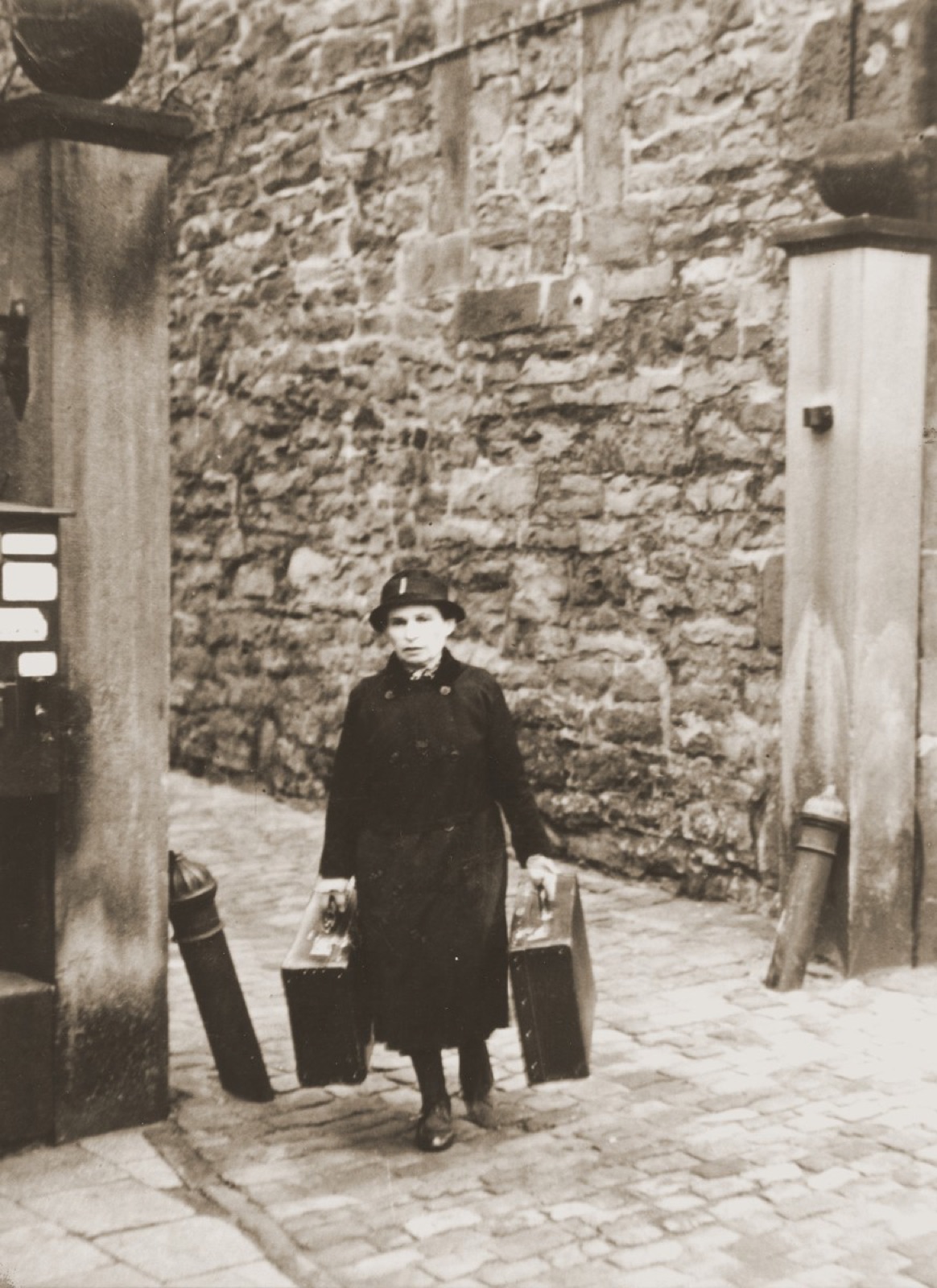
Photographer unknown · 1938-11-10 · United States Holocaust Memorial Museum, courtesy of Stadtarchiv Stadthagen, USHMM pa1120169 United States Holocaust Memorial Museum View the record: Stadthagen, November 10, 1938. A woman leaves her house with a
We were taken to a closed entrance of the Tivolistr. train station. Young SS men were standing there. They hit us with their sticks and shouted 'Go to Palestine' as we went downstairs.Hans Block, a lawyer in Hanover, on the walk to the train that took him to Weimar and Buchenwald. Written in December 1939. Yad Vashem Archives.
For teachers and students
One letter to read closely, and five questions worth an hour of class.
A classroom needs a primary source that will actually play. Project Witness films survivors at length and puts the finished interviews online free, with no account and no subscription, so a teacher can show a whole testimony inside a period instead of a thirty second clip with a link out to somewhere else. What follows is what a teacher can build an hour on: a letter the mayor of Chemnitz wrote about the city's burned synagogue two days after the fire, and the questions to ask about it.
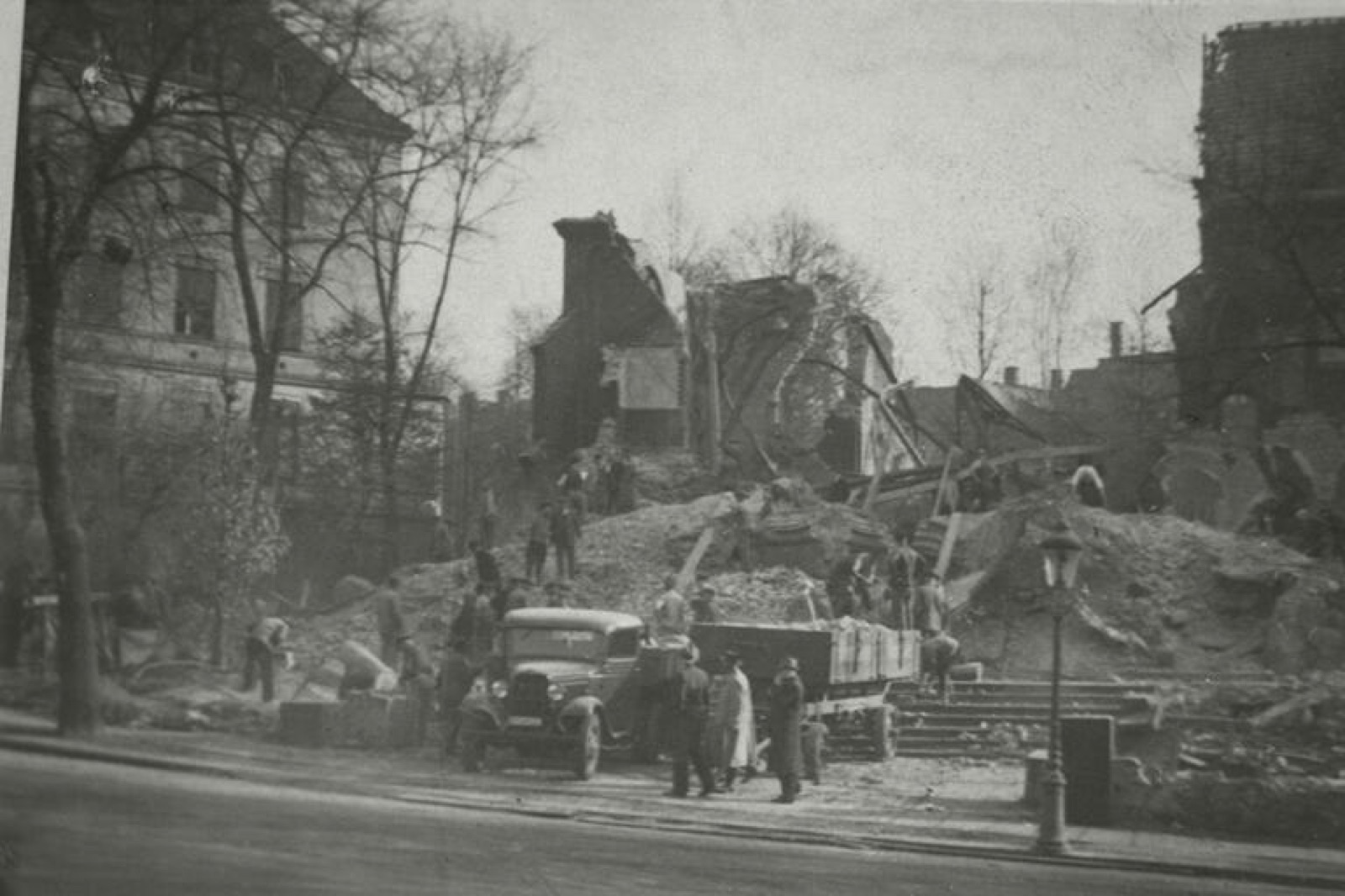
Photographed at the time Wolf Hoffmann · 1938-11-09 · Leo Baeck Institute, New York, published on Flickr Commons by Center for Jewish History, NYC, Call Number AR 813 No known copyright restrictions; may be subject to third party rights. Flickr Commons usage: rights statement for Chemnitz, November 1938. Workmen standing on what is left of the View the record: Chemnitz, November 1938. Workmen standing on what is left of the
the synagogue [...] which caught fire in the night from November 9th to 10th, 1938... A permit for the rebuilding of the synagogue in the same place is out of the question.The mayor of Chemnitz to the city's Jewish community, two days after the synagogue burned. Two passages, as the Leo Baeck Institute quotes them. Leo Baeck Institute, 1938Projekt, Chemnitz Jewish Community Collection AR 813.
How it has been marked
The answer started inside the Jewish community within weeks, in print, in relief work, and in shul.
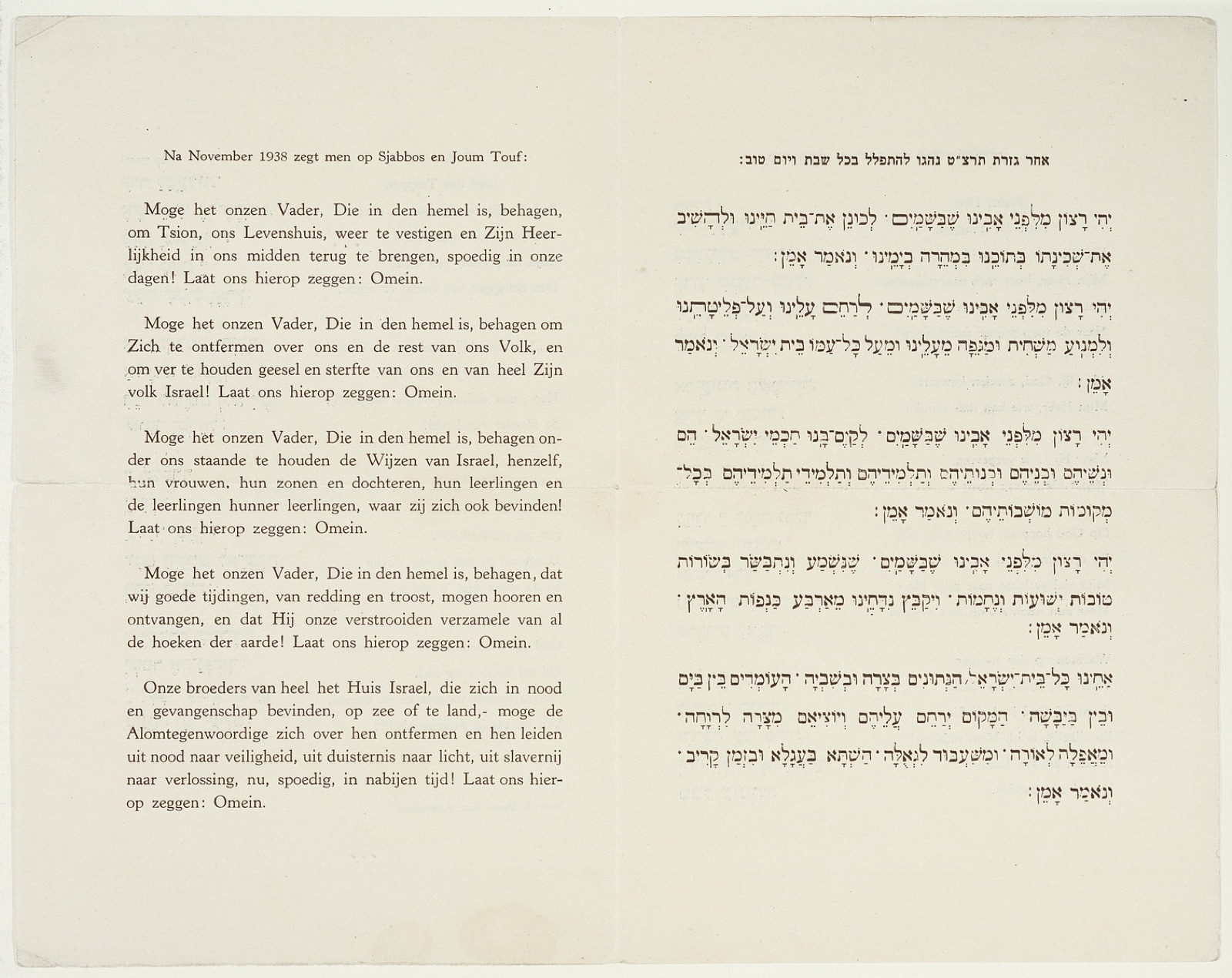
Photographer unknown · 1938 · United States Holocaust Memorial Museum, courtesy of Ilse (Lichtenstein) Meyer, USHMM pa1156968 United States Holocaust Memorial Museum View the record: The Netherlands, 1938. A prayer printed in Hebrew with a Dutch text
For roughly two weeks after the pogrom, German Jewry had no legal way to speak to itself in print at all. Every Jewish paper had been closed, and the one that replaced them, the Juedisches Nachrichtenblatt, first appeared in Berlin on November 23, edited by Jews and controlled by the Propaganda Ministry, carrying what the authorities found acceptable and a great deal about emigration.
The answer came in other forms. On December 1 the American Jewish Joint Distribution Committee's emissary George Rooby reported back on what he had found in Berlin, Nuremberg, Fuerth and Frankfurt: burned synagogues, ransacked shops, desecrated Torah scrolls, and a Jewish leadership either forbidden to operate or already in the camps. He wrote that for the Jews of the Reich there existed no other solution but to emigrate. Community leaders assured him there was enough money for immediate relief; the organizations working to get people out were badly short of funds.
The printed prayer beside this paragraph is the older kind of answer. Somebody in the Netherlands sat down that same year, wrote a tefillah for the murdered, and had it set in Hebrew with a Dutch text beside it, to be said on Shabbos and yom tov.
Kristallnacht in dates
March 1938 to September 1939, from the annexation of Austria to the month the doors closed.
Kristallnacht is two days. Everything else on this list is either what made those two days possible or what was done with them afterward. The entries from the summer and autumn of 1938 are the ones to read slowly. Synagogues were being pulled down and congregations attacked in their own shuls well before the night that got the name.
Show the other 22 dates
Questions people ask
Ten short answers, each one written so it survives being quoted on its own.
Where institutions disagree, the answer says so rather than picking the tidier figure. Where a familiar number does not mean what it is usually taken to mean, the answer says what it does mean.
When was Kristallnacht?
Why is it called the Night of Broken Glass?
Why did Kristallnacht happen?
How many synagogues were destroyed on Kristallnacht?
How many people were killed on Kristallnacht?
How many Jews were arrested on Kristallnacht?
Who ordered Kristallnacht?
Who took the photographs of Kristallnacht?
What happened to Jewish people after Kristallnacht?
How do I explain Kristallnacht to children?
How we know
Named institutions, named documents, and the credit for every image on the page.
Most of what is known about November 1938 in detail comes from the people who did it. The orders survive because the Gestapo used a teleprinter and kept the tape. Heydrich put the first figures in writing for Goering inside thirty-six hours. A stenographer sat in the room at the aviation ministry while the insurance was settled, and typed what was said. Even the killings were counted, because the Nazi Party ran a disciplinary court of its own and kept its own docket. All of it was gathered as evidence at Nuremberg, and all of it is free to read now.
The rest comes from three other places. Foreign diplomats in Germany cabled their governments while it was happening, and those cables were published. Jews wrote it down: in letters within days, in testimony after the war, and on film, which is the part Project Witness holds. And German municipal and Jewish community archives kept photographs and correspondence that local historians spent forty years assembling into something that could be counted.
Where these sources disagree, this page prints the disagreement instead of choosing. That happens on the death toll, on the number of synagogues, on the number arrested, on the number of deaths at Buchenwald, and on how many days the violence lasted.
- United States Holocaust Memorial Museum, Holocaust Encyclopedia: Kristallnacht. The baseline narrative, the orders, the arrests, the decrees.
- United States Holocaust Memorial Museum: 1938 Key Dates. The decree-by-decree chronology.
- Yad Vashem: Kristallnacht or the November Pogrom? On the name, and on why the violence cannot be confined to one night.
- Jewish Museum Berlin, on November 9, 1938. The property levy, the school expulsions, and the German objection to the word Kristallnacht.
- Deutsches Historisches Museum, LeMO: Novemberpogrome 1938.
- Leo Baeck Institute, 1938Projekt: the November pogrom, day by day, from the collections.
- Buchenwald Memorial: the special camp for the November pogrom.
- Harvard Law School Library, Nuremberg Trials Project: Heydrich's report to Goering, November 11, 1938.
- The Avalon Project, Yale Law School: the stenographic minutes of the Goering conference, November 12, 1938.
- Office of the Historian, US Department of State: the ambassador in Berlin to the Secretary of State, November 12, 1938.
- The National Archives, Kew: the Ogilvie-Forbes telegram from Berlin, November 10, 1938, FO 371/21636, as scanned by the Archives.
- The National WWII Museum: Kristallnacht, the Night of Broken Glass.
- Claims Conference: Remembering Kristallnacht.
- Anne Frank House: the impossibilities of escaping, Jewish emigration 1933 to 1942.
- Wiener Holocaust Library: 356 eyewitness accounts collected in the days and weeks after the pogrom.
- Bayerische Staatsbibliothek, 1000 Schluesseldokumente: the Goebbels diary entries of November 1938.
- Yeshivat Har Etzion: the life of Rabbi Yechiel Yaakov Weinberg.
Every fact here comes from a named institution. Most of the images are public domain or carry a free license, and where the license asks for attribution the credit runs with the image. Two photographs belong to the United States Holocaust Memorial Museum and appear under its terms for educational use, with its credit line beside each one.
Where to go from here
This page ends in September 1939. The rest of it is on the pages below.
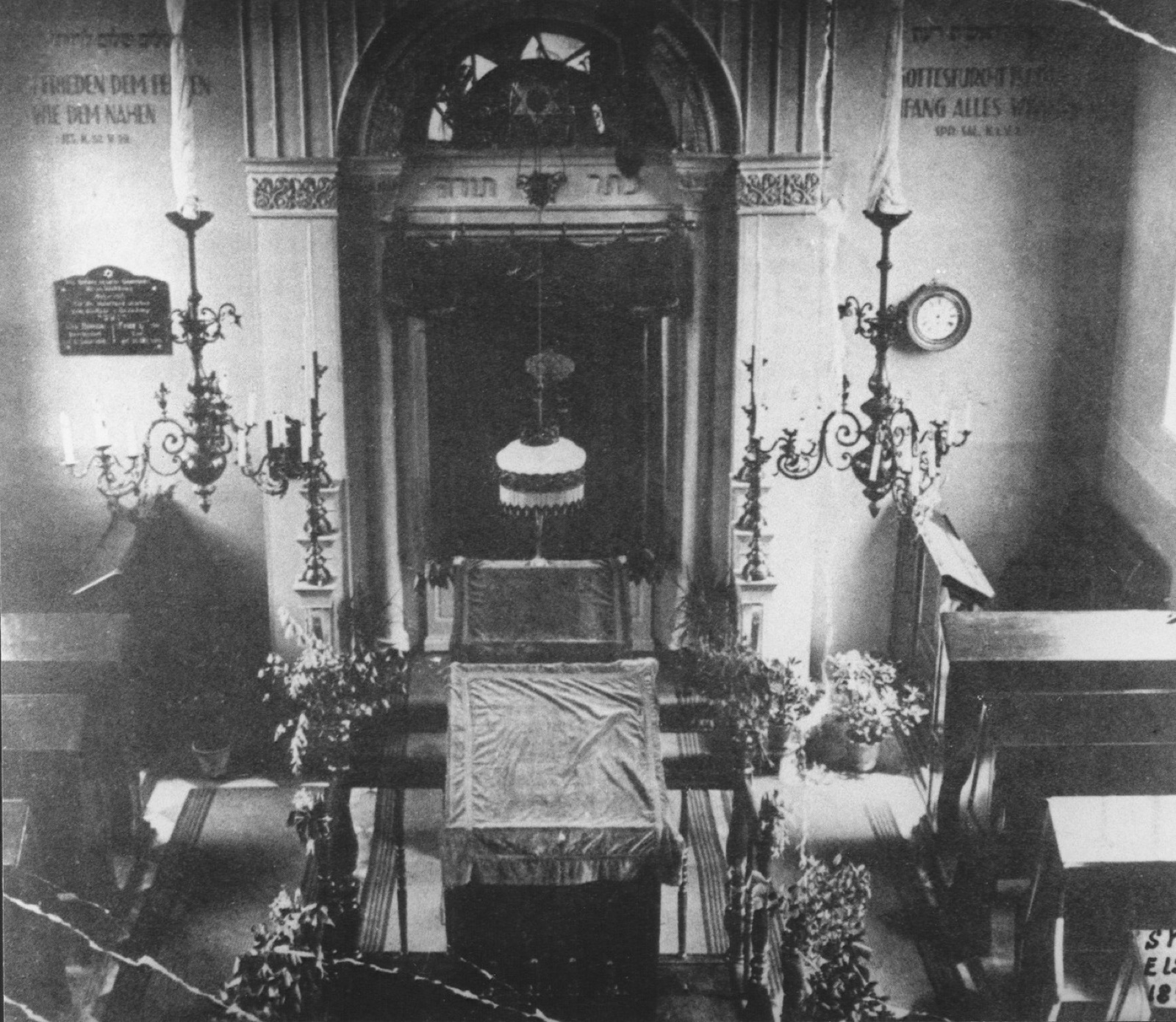
Photographer unknown · Before 1938 · United States Holocaust Memorial Museum, courtesy of Stadtarchiv Pulheim, USHMM pa1126998 United States Holocaust Memorial Museum View the record: Elsdorf. The sanctuary of the town synagogue, photographed while it
November 1938 has a story on both sides of it. This page runs from the annexation of Austria in March 1938 to the month the war closed the last routes out, and it stops there deliberately. What the men released from Dachau and Buchenwald walked back into, what the camps became after them, and who was eventually made to answer for any of it are all on other pages.
The strongest single thread out of this one runs to the ghettos. Emanuel Ringelblum spent five weeks at Zbaszyn in the autumn of 1938 organizing relief for people Germany had pushed to the Polish border and Poland would not let in. Two years later, in the Warsaw ghetto, he built the underground archive that was buried so that somebody afterward would know what had happened there.
- Auschwitz. What the policy of forced expulsion turned into after emigration was forbidden.
- Perpetrators and justice. The Nuremberg documents quoted on this page, and what happened to the men who signed them.
- The film and testimony library. Every Project Witness testimony that is online, free, in full.
Words used on this page
Show the term
- Aktion
- German for an operation or action, and the regime's word for its organised measures against Jews. The authorities called the November 1938 pogrom an Aktion. In the occupied east the word named a mass shooting, which usually began with German units and local collaborators rounding up the Jewish residents of a village, town or city. Source 1: USHMM Holocaust Encyclopedia, Kristallnacht, for AktionSource 2: USHMM Holocaust Encyclopedia, Mass Shootings of Jews during the Holocaust, for Aktion